
Closing the AI Gap: How to Move Shadow Workflows into Approved Systems
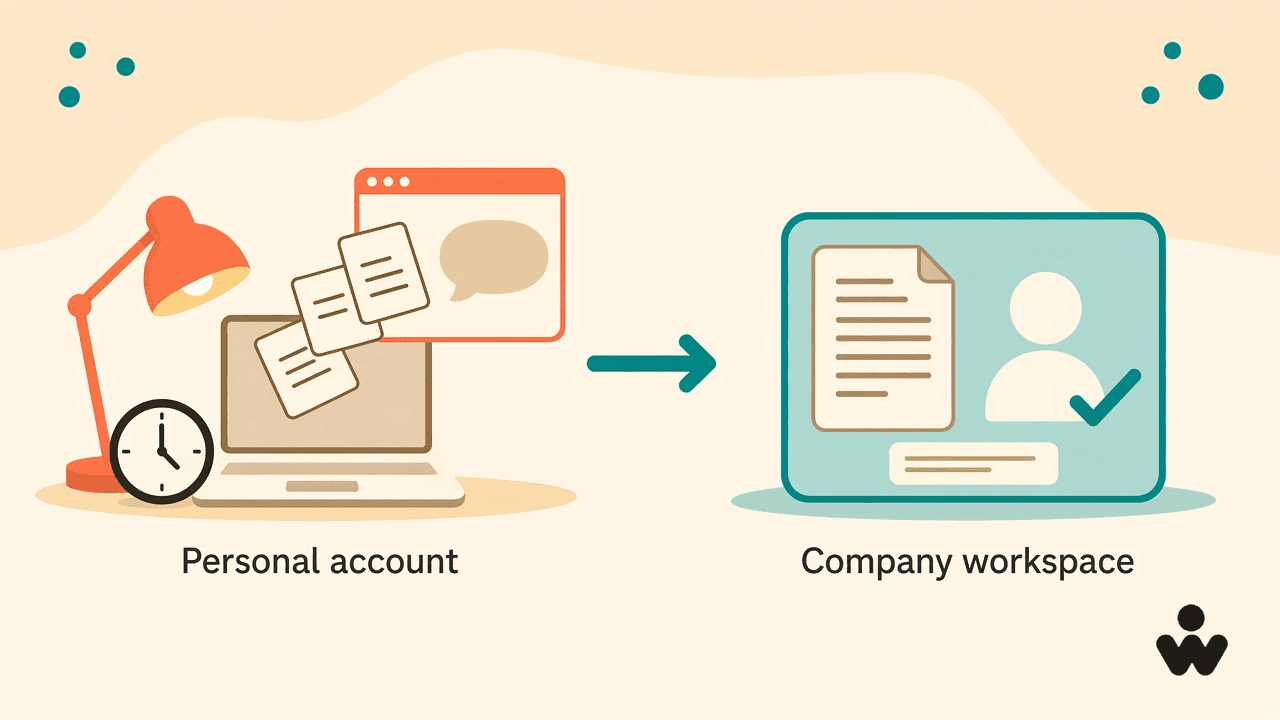
In the last article, we discussed what shadow AI is, why employees turn to unapproved tools, the risks that matter for a business, and a practical framework — inventory, plain data rules, workflow approvals, limited permissions, and a named person on consequential steps.
This article continues from there. We look at the unofficial pilot that is already in production while the official one is still on a slide: how to spot it, how to read its backlog of pastes, and how to replace one workflow in two weeks so the governed path catches up.
The official AI pilot has a slide. It shows a chatbot that quotes the handbook, a vendor demo date, and a usage chart that still looks early.
Friday’s work does not wait for that slide.
A sales manager finishes the week’s follow-ups in a personal chat account. Finance settles an invoice exception the same way. HR rewrites a sensitive note. Engineering pastes an error and a slice of internal code “just this once.”
Your company is not waiting to adopt AI. It is running two programs at once: the pilot leadership reviews, and the unofficial one that already ships the work.
The unofficial pilot has a different success metric
The official pilot optimizes for a safe first use case: a handbook answer, a controlled demo, a report that says “we started.”
The unofficial pilot optimizes for Thursday at 5 p.m. It wins when the email goes out, the quote lands, the bug moves, or the policy question gets an answer before the meeting.
That is why the two programs diverge so fast. The approved chatbot can recite last year’s policy. It cannot see this account’s history, this quarter’s price list, or the template the team actually sends. The person who owns the outcome leaves, opens the tool that can draft, and pastes whatever the draft needs.
The paste is not a policy failure first. It is a product failure. The unofficial pilot exists because it finishes the job the official one still cannot.
How to spot it without a security incident
You will not find the unofficial pilot in the vendor dashboard. Look for the workarounds people already treat as normal.
- A personal subscription used for company deadlines — “my ChatGPT,” “my Claude,” paid on a personal card, open beside the CRM
- The same paste every week — customer list on Tuesday, invoice thread on month-end, candidate note before the offer call
- A side tab that never closes — company tool for the allowed question, personal tool for the one that has to ship
- Language that hides the tool — “I’ll polish this,” “I’ll get a draft,” with no mention of where
- Work that disappears on offboarding — drafts, prompts, and context that lived only in an account IT never provisioned
None of those show up as “AI adoption” in the pilot report. All of them are adoption.
The unofficial backlog is already written
The unofficial pilot does not need a roadmap. Its backlog is the list of pastes people retype when the company system stalls:
| Recurring paste | Unofficial outcome | What the company never sees |
|---|---|---|
| Customer names and deal stage | Follow-up sent before Friday | A slice of the pipeline, with no retention control |
| Pricing notes and discount history | Quote that “feels right” | Commercial judgment outside any audit |
| Contract clauses and vendor threads | Reply drafted in time | Legal context the company cannot search later |
| Resumes, performance notes, HR cases | Message rewritten under pressure | Personnel data in an account that outlives the role |
| Meeting notes and unannounced decisions | Action list for the next morning | Strategy that left the room without a ticket |
| Internal code, logs, architecture | Bug unblocked tonight | Implementation detail, sometimes with credentials buried in |
The risk is not only leakage in the abstract. It is a second operating system for the business — one with no owner, no delete path, and no answer when someone later asks where else this information lives.
That is the unofficial pilot’s production environment.
Catching up is a race against one deadline, not a new policy
A ban describes the risk. It does not finish the email.
If the official program answers with a sharper prohibition while the unofficial one still drafts faster, the paste moves to a phone, a personal browser, or a note app. You get quieter employees and the same backlog.
Catching up means beating the unofficial pilot on its own metric: finish this Friday’s task inside an approved path. One workflow. One owner. One checkpoint before anything external or irreversible — the same placement a human-in-the-loop design uses when the step cannot be undone.
The last article gave the inventory, data guide, and approval templates. This extension applies them to one paste at a time. The unit of progress here is a single replaced workflow.
A two-week catch-up
Start with the unofficial backlog, not a new policy PDF.
- Ask five people what they retype into AI every week. Include managers. Useful answers name a deadline: “Tuesday pipeline follow-ups,” “invoice exceptions,” “candidate rejection rewrite.”
- Write the finished outcome the unofficial pilot already delivers. “Follow-up sent and logged,” not “we should use AI more.”
- Mark what must stay inside the company for that outcome. If the task needs customer data, pricing, personnel, code, or credentials, it needs an approved system — not a louder warning.
- Pick one workflow with a deadline and a named owner. One path. Department-wide rollout comes after this one ships.
- Put an approved agent on that path. Company knowledge, the tools the team already uses, and a person before anything that leaves or cannot be undone.
- Say out loud that this job may be done there. Silence reads as “still don’t,” and the personal account stays open.
- Check whether that paste stopped. The signal is completed work inside the company, with a trail. Quieter employees are not the metric.
Teams that start with a prohibition keep two programs: a slide deck and an unseen backlog. Teams that replace one painful workflow give the official program its first real production win.
How WellSkate AI closes the gap
WellSkate AI is built to win the unofficial pilot’s job without leaving the company: custom agents and Agentic Workflows on company knowledge, in Slack, Teams, and email, with a record of what happened and a named person on the irreversible step.
Shadow AI ends as an unofficial production system when the approved path is the fastest way to finish Friday’s work — and leadership can finally see the work that used to live only in personal accounts.
Frequently asked questions
What is an unapproved AI pilot?
It is company work already finishing in personal or unsanctioned AI tools while the official pilot is still a demo, a handbook bot, or a usage chart. The unofficial program ships the deadline; the official one reports on starting.
How does this extend the last Shadow AI article?
The last article defined shadow AI, the risks, and the governance framework. This one extends that into operations: how to spot the unofficial pilot already shipping work, read its backlog of pastes, and replace one workflow in two weeks so the approved path catches up.
How do you find the unofficial pilot without waiting for an incident?
Look for personal subscriptions used on company deadlines, the same weekly paste, a side tab that never closes, vague language about “polishing” a draft, and work that vanishes when someone leaves because it lived in an account IT never provisioned.
Why doesn’t a ban shut the unofficial pilot down?
The deadline does not move. If the approved tool still cannot finish the task, the paste moves to a phone or a personal browser. You need a faster approved path for that specific workflow, not only a sharper rule.
What should the first two weeks replace?
One recurring paste with a named owner and a finished outcome. Put an approved agent on that path, say the job is allowed there, and check whether that paste stopped — not whether employees got quieter.
Want to replace one unapproved workflow with an agent your team is allowed to use? Explore WellSkate AI at wellskate.ai or contact contact@wellskate.ai.