
Human in the loop is not a checkbox — it is how enterprise AI actually ships
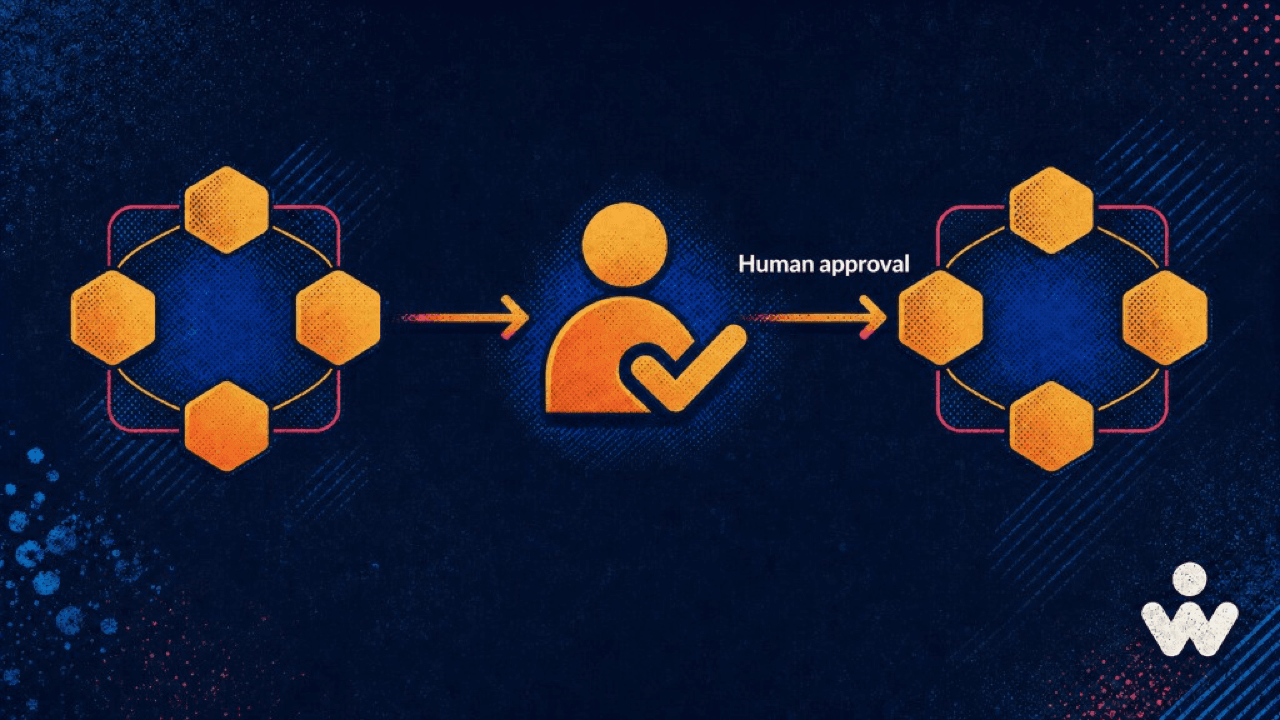
Most enterprise AI programs talk about autonomy as the goal. Faster answers. Fewer tickets. Agents that “just handle it.”
Then security asks who approved the outbound email. Legal asks who owns the wrong decision. A manager asks why a record changed overnight. The pilot freezes — not because the model was incapable, but because nobody designed the human into the work.
Human-in-the-loop (HITL) is usually treated as a safety sticker: a review step bolted on after the demo, or a vague promise that “someone will check important things.” In production, HITL is not a sticker. It is the operating model for how AI and people share judgment, risk, and accountability.
If you cannot name where a human sits in the loop, you do not have an enterprise AI implementation. You have a demo with unpaid supervision debt.
Autonomy without design is just deferred risk
Fully autonomous agents sound efficient in a slide. In a company, autonomy without checkpoints creates three problems at once:
- Accountability gap — when the outcome is wrong, nobody can say who decided
- Trust cliff — teams trust the agent until the first expensive mistake, then trust nothing
- Rubber-stamp theater — humans “approve” everything because the system dumps volume they cannot meaningfully review
Those failures look different on the surface. They share a root cause: the loop was never designed. The agent was allowed to act, or the human was asked to watch everything, with no rule for when judgment is required.
Enterprises do not need maximum autonomy on day one. They need controlled completion — agents that finish repeatable work, and humans who own the moments that still require judgment, authority, or liability.
What human-in-the-loop actually means
HITL is not “a person chats with the model.” It is a deliberate placement of human authority inside an automated path.
In practice, a human can sit in three places:
| Role | What the human does | When it fits |
|---|---|---|
| Steer | Set goals, constraints, and context before the agent runs | Ambiguous requests, new workflows, high-context work |
| Approve | Review a prepared packet and authorize the next irreversible step | External sends, record updates, money movement, policy exceptions |
| Recover | Take over when confidence is low, policy conflicts, or tools fail | Edge cases, incidents, conflicting sources |
Chatbots mostly use humans as the interface. Agentic Workflows use humans as checkpoints — on the same path the work already travels.
That distinction matters. If the human’s only job is to re-type what the model said into Slack, email, and the system of record, you did not add HITL. You added unpaid labor.
Three failure modes that kill trust
1. Autopilot on irreversible steps
The agent drafts and sends. Closes the ticket. Updates the CRM. Approves the exception. Nobody saw the action until a customer or auditor did.
This is not speed. It is silent liability. Irreversible steps need a gate proportional to impact — not a hope that the model is usually right.
2. Human as bottleneck for everything
Every draft, every triage, every lookup waits for a person. The agent becomes a fancy queue. Throughput does not improve; it just changes shape.
HITL that reviews 100% of low-risk steps is not governance. It is fear with a UI.
3. Approval without context
A manager gets a notification: “Approve?” No sources. No diff. No policy excerpt. No confidence signal. They click yes to clear the inbox, or no to stay safe.
That is not human judgment. That is theater. A checkpoint only works when the human receives a decision packet: what changed, why, what sources were used, and what happens if they approve.
Design the loop by risk, not by slogan
A useful enterprise rule: automate preparation; gate irreversible impact.
Map each step in the workflow to one of four modes:
- Auto — agent completes without interruption (low impact, high confidence, reversible or easily corrected)
- Propose — agent prepares; human must approve before the next step (external communication, system-of-record writes, policy exceptions)
- Escalate — agent stops and routes to a named owner with context attached (conflicts, low confidence, sensitive categories)
- Human-owned — agent must not act; only assist with retrieval or drafting under explicit request (investigations, terminations, legal strategy, compensation decisions)
Most companies reverse this. They ask “how autonomous can we be?” instead of “which steps already require a human today — and which never did?”
If leave requests already need a manager signature, the agent should prepare the packet and route the approval — not invent a new portal, and not skip the signature. If FAQ answers are already self-serve, forcing a human review on every reply recreates the helpdesk you were trying to shrink.
Where humans must stay (for now)
Not every checkpoint is temporary. Some are structural:
- Authority — only certain roles can commit the company externally or change records of record
- Liability — regulated actions need a responsible human, not only a model version string
- Values and exceptions — policy covers the common path; people handle the case the handbook never imagined
- Relationship — some messages should sound like a person because they are a person’s commitment
The goal of enterprise AI is not to erase those moments. It is to stop burning skilled people on the work around them: searching, assembling context, chasing, copying, and reminding.
A strong HITL design frees humans for judgment. A weak one either removes them too early or traps them in review spam.
Make checkpoints operational, not ceremonial
Production HITL needs product mechanics, not a policy PDF.
Minimum bar for a checkpoint that works:
- Right person — routed by role, not “whoever is online”
- Right timing — before irreversible action, not after the blast radius
- Right packet — sources, proposed action, risk flags, and a clear approve / edit / reject path
- Same surfaces — Slack, Teams, email, or the approval tool the team already uses
- Audit — who triggered, what the agent saw, what it proposed, who decided, what executed
- Escape hatch — escalate or take over without restarting the whole workflow from scratch
If your “human oversight” is a weekly meeting that reviews sample chats, you are doing quality sampling. That can help. It is not a loop. The loop sits on the critical path of the work.
A practical placement sequence
Do not start with “add AI everywhere with oversight.” Start with one outcome and place people deliberately.
- Name the finished outcome — “vendor reply sent and logged,” not “procurement AI”
- List irreversible steps — anything that leaves the company, moves money, or changes a system of record
- Mark today’s human owners — who already approves, escalates, or signs off
- Assign Auto / Propose / Escalate / Human-owned to each step
- Define the decision packet for every Propose and Escalate step
- Measure trust, not only speed — approval latency, edit rate, reopen rate, and incident count after go-live
- Widen autonomy only after the packet earns it — steps with low edit rates and clear reversibility can move from Propose to Auto
Teams that skip step 4 ship a demo. Teams that skip step 6 never know whether the loop is helping or just decorating the workflow.
How WellSkate AI approaches this
WellSkate AI is built for Agentic Workflows where humans stay on the approvals that already matter — without making people the search layer, the copy-paste layer, or the reminder bot.
- Agents prepare; people authorize — multi-step work can plan, gather context, and draft the next action, then pause where policy or impact requires a human
- Checkpoints on existing paths — approvals and escalations land in the collaboration surfaces and ownership patterns teams already use
- Permissions and policy in the runtime — agents inherit access from the triggering user; sensitive content and tool use are constrained beyond the prompt
- Audit that survives review — traces show what was accessed, proposed, approved, and done, so security and operators are not reconstructing last Tuesday from memory
The point of human-in-the-loop is not to slow AI down. It is to make AI shippable: trusted enough for real work, governed enough for real risk, and designed so skilled people spend time on judgment instead of unfinished automation.
If your last pilot was impressive until someone asked “who approved that?”, the missing piece was not a stronger model. It was a designed loop.
Want to put human checkpoints on a real enterprise workflow? Explore WellSkate AI at wellskate.ai or contact contact@wellskate.ai.