
The hidden cost of building AI agents is time and expertise, not the model bill
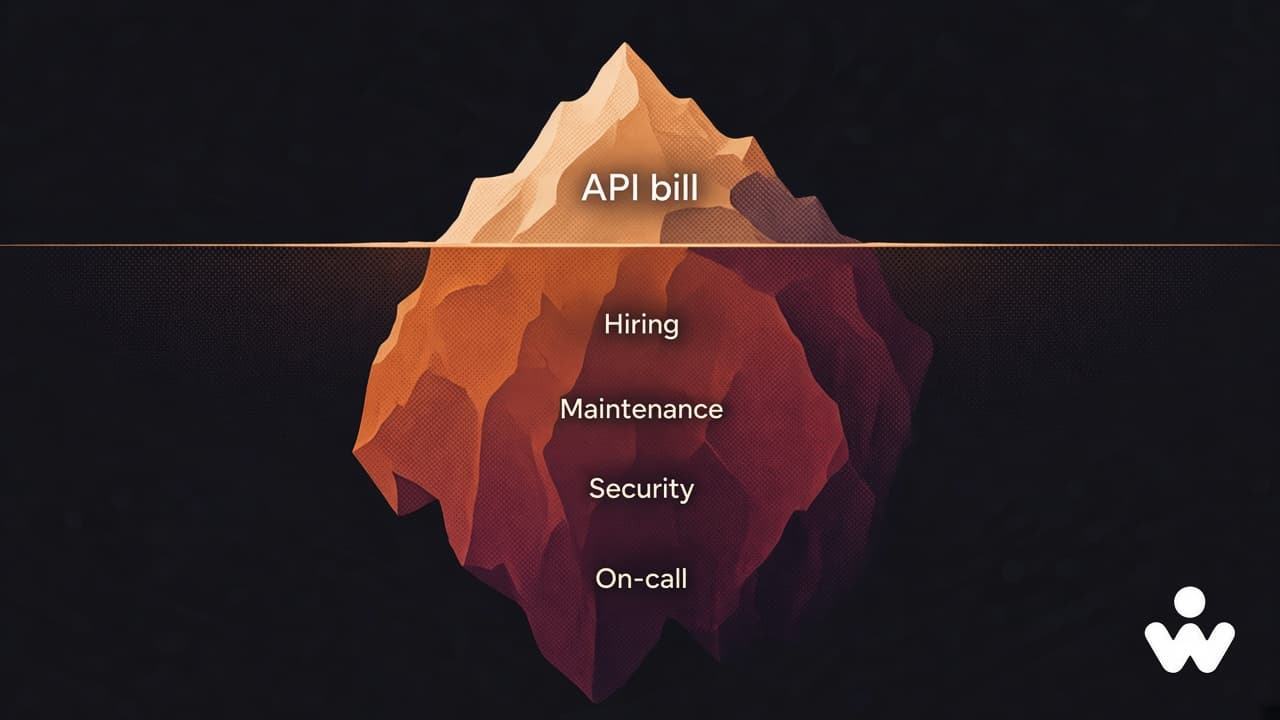
The first number leadership sees is small. A few thousand dollars of model usage. A polished demo. A slide that says the company can “just build agents.”
That pattern is familiar among Japanese enterprises shopping for low-cost enterprise AI tools. We see the same gap: the software line looks modest, then specialist hiring and maintenance arrive as the operating budget.
That number is not the budget. Building production agents takes expert time — to hire, to ramp, and to keep the work running after go-live. People still design the outcome, connect real systems, keep quality high, answer security, and stay responsible when the process changes. The model invoice does not pay for any of that.
Teams that fund software and a short project almost always under-plan the time and cost of specialists, and the time and cost of maintenance that follows.
The model bill is a line item. The time and cost of expert hiring and ongoing maintenance are the operating budget.
The invoice you can see is not the cost you will carry
Finance can see software. The larger lines sit in recruiting cycles, fully loaded compensation, onboarding, and the months your experts spend keeping the agent current.
| What the budget shows | Time and cost that usually sit behind it |
|---|---|
| Model usage | Compensation and ramp for AI and platform specialists |
| A prototype project | Expert time after go-live, not only before the demo |
| A few system connections | Ongoing time to keep those connections working |
| A launch review | Recurring quality, policy, and security time |
| A successful demo | Coverage when something goes wrong in production |
A useful ratio, not a fake spreadsheet: the people line is often an order of magnitude larger than the model line. If year-one software is tens of thousands, ask what two specialists cost to hire and ramp — and what a year of maintenance time costs after they are in place. That is the real TCO of “we’ll just build it.”
This is not an argument against hiring. Specialists are how serious programs succeed. It is an argument for budgeting their time and cost honestly, instead of treating the model bill as the investment.
A production agent needs expert time after the launch
A production agent is not a chatbot the business can “try.” It is an internal capability. Capabilities need skilled people after the launch party, not only during the prototype.
Expert time goes into:
- Translating a business outcome into a workflow the agent can actually finish
- Connecting chat, email, documents, and systems of record — and keeping those connections healthy
- Watching quality as policies, documents, and models change
- Answering who acted, what data was used, and who approved it
- Responding when the agent does the wrong thing in front of a customer or an auditor
That work is valuable. It is also slow to staff and expensive to sustain if every new agent requires the same specialist cycle.
Build is justified when the agent is the business — a capability customers pay for, and a team you will fund after launch. It is not justified because a demo looked inexpensive and the hiring plan was left for later.
The time and cost of hiring experts
The expensive part of a build is rarely the model. It is the lead time and compensation required to bring the right experts onto the work.
A serious internal build usually needs some mix of:
- AI or platform expertise — to own the agent as a system, not a prompt
- Integration and IT time — to connect the tools the process already uses
- A business owner — who can define “done,” exceptions, and approvals
- Security and legal time — before the agent is allowed to act on real work
- An executive sponsor — who still cares after the prototype is shown
Those skills are scarce. Recruiting takes months. Ramp takes more months. Fully loaded cost includes compensation, search, onboarding, and management attention. A two-person specialist team can cost more in one year than several years of model usage — before you count the calendar you spent waiting for them.
There is a second time cost: what those experts could be doing instead. Every month a strong engineer, IT lead, or operations manager spends standing up undifferentiated platform work is a month they did not spend on the process that actually creates value. The people are not the problem. Where their time goes is the planning question.
If the timeline only works because one senior expert is “available for now,” you have not priced hiring or coverage. You have priced a temporary gap.
The time and cost of maintaining agents
Agents do not stay finished. Policy changes. A system is replaced. The rare exception becomes the volume. A new model behaves differently. The approver moves to another team.
Maintenance is the cost companies forget because the prototype had a project end date. Production does not. Hiring gets the agent to the starting line. Maintenance is the ongoing time and cost of keeping it there.
In practice, maintenance looks like expert time:
- Keep it connected — tools, permissions, and records drift; someone has to notice
- Keep it trusted — a single bad send or wrong record update can freeze the program
- Keep it current — last quarter’s process, still running, becomes a workaround in Excel
- Keep it supported — reviews, incidents, and a named owner when something breaks
This is why so many AI pilots fade after the demo. The project team returns to other priorities. No time is reserved to operate the agent. The business still copy-pastes. You paid for a prototype, then paid people to finish the work anyway.
A useful question for leadership is not “what does the software cost?” It is: how much expert time will maintenance take every quarter — and is that in next year’s plan, not only this quarter’s project?
If every process change needs a specialist cycle, you have priced a standing capability. If a business owner can update the workflow and policy, you have priced an operating model.
Delay has a time and cost too
Enterprises rarely stop agent programs because the demo was weak. They pause them when security, legal, or a business owner cannot answer:
- Who is accountable for what the agent did?
- What data did it use?
- Who approved the email, the ticket close, or the record change?
- Can we explain last Tuesday to an auditor?
Those questions arrive after the showcase. Every month of freeze is paid expert time with no production outcome: specialists waiting, sponsors cooling, operators still on the manual path. Governance postponed is not speed. It is calendar and compensation spent on a workflow that still is not live.
The lowest-cost moment to design ownership, permissions, and approvals is before the first department-wide rollout. After that, recovery costs more time from the same experts you hired to move forward.
Put time and cost on one page
| Line | Why it hides | What to plan |
|---|---|---|
| Hiring experts | “We already have engineers” | Recruiting lead time, compensation, ramp |
| Expert focus | They are already on payroll | Months spent on platform work vs. the process |
| Maintenance | The project had an end date | Recurring time after go-live |
| Quality and trust | Assumed after the demo | Ongoing review time |
| Security and legal | Treated as a later phase | Calendar delay and extra cycles |
| Production support | Agents look like chat | Coverage when something goes wrong |
| Process change | The happy path looks stable | Expert time for every update |
None of this means “do not hire” or “never build.” It means do not confuse a small prototype spend with a small operating model.
Build when the agent is strategic differentiation and you can fund expert time after launch, not only during it. For most enterprise work — onboarding, exceptions, approvals, customer follow-up — the expensive mistake is spending specialist hiring cycles and maintenance time on platform work for one process. The build vs buy vs assemble choice is the same cost question in another form.
What low-cost enterprise AI in Japan actually means
Searches for low-cost enterprise AI tools in Japan are usually a TCO question, not a hunt for the smallest license.
Work in Japanese companies still runs through Slack, Teams, email, shared drives, and approvals. A tool that answers in a chat window, then leaves people to finish the job in Excel, is not low cost. Japanese SME AI pilots stall for the same reason: the demo is funded; the operating path is not.
Low-cost enterprise AI in this market looks like:
- Workflow automation that finishes an outcome — not only a reply — on the tools teams already use
- No new specialist cycle for every process — business owners can change the workflow without waiting on a platform hiring plan
- Maintenance in next year’s budget — not only in this quarter’s prototype
- Governance on the first workflow — so security review does not freeze the program after the showcase
That is why assemble-on-a-platform is often lower total cost than building an internal agent stack for one process. You still need experts. You spend their time on the process, not on standing up undifferentiated infrastructure.
Questions leadership should ask before approving a build
Skip the 40-row scoring matrix. Ask these before you lock the budget:
- What finished outcome are we buying? — “invoice exception ready for approval,” not “finance AI.”
- What does hiring the experts take? — lead time, compensation, ramp — not only a start date on a slide.
- What does maintenance take after go-live? — hours per quarter, named owners, coverage when something breaks.
- Where should expert time go? — platform plumbing, or the process that is uniquely yours?
- When does security see it — before rollout, or after the demo tour? — freeze after the showcase is more time and cost.
- What happens after the first workflow? — if the second process needs the same specialist cycle again, you are funding infrastructure, not an agent.
If you cannot name the maintenance time in next year’s plan, you are not ready to build. You are ready to run another demo.
How WellSkate AI approaches this
At WellSkate Co., Ltd. in Tokyo, we build WellSkate AI so Japanese and global teams can put expert time on the work that is actually theirs — not on standing up and maintaining an agent platform for every process.
The people who understand the work best should turn that understanding into custom AI agents and Agentic Workflows. Specialists still matter. The difference is where their months and budget go: the outcome, the exceptions, and the knowledge — not a second operating system for AI.
Business teams can operate the agent. Expert time stays on the process. Identity, execution, logging, and admin controls are the platform’s job. Operations, HR, finance, and sales define the outcome. Dedicated AI engineers do not have to sit on the critical path every time policy or process changes. Frontier models sit behind a single subscription, so model access is not a long hiring or procurement cycle.
Work stays where people already are. Agents ground in the policies, documents, and process context the company already has. They join Slack, Teams, email, and the systems of record already in use. Employees are not asked to move to a parallel AI workplace — and your experts are not asked to rebuild that workplace.
Ownership is designed in from the first workflow. Agents inherit the permissions of the person who triggered them. Policies constrain what can be accessed and shared. Approvals and audit trails travel with the workflow, so security review does not have to invent a stack — or a recovery program — after the demo.
That is the point of the platform: you pay for infrastructure that already carries the undifferentiated work, and you spend scarce expert time on the process that is actually yours.
If your last agent investment produced a demo, a model bill, and a surprise hiring-and-maintenance plan, the missing number was not a better software price. It was the time and cost of the expertise behind it.
Frequently asked questions
What makes enterprise AI tools in Japan low cost in practice?
Low-cost enterprise AI in Japan is total cost of ownership, not the smallest software invoice. Work still runs through chat, email, documents, and approvals. A tool is lower cost when business teams can run workflow automation without a new specialist hiring cycle for every process, and when maintenance time is in next year’s plan — not only in the prototype.
Does choosing a low-cost enterprise AI tool in Japan mean skipping specialists?
No. Specialists are how serious programs succeed. The cost question is where their time goes: standing up an agent platform for each workflow, or the process that is uniquely the company’s. Platforms that already carry identity, connectors, and governance keep expert time on the work.
How should Japanese enterprises compare a chatbot license with workflow automation?
A chatbot license is usually a line item. Workflow automation has to finish work across the systems people already use. If employees still copy answers into Slack, Excel, and the system of record, you paid for advice and still pay people to complete the job.
Want to put expert time on the process, not on standing up and maintaining an agent platform? Explore WellSkate AI at wellskate.ai or contact contact@wellskate.ai.