
Why Japanese SMEs struggle with AI pilots — and how business-led agents change the adoption path
Across Japan, more small and mid-sized companies are running AI pilots. Many of those pilots look promising in the first few weeks: a chatbot answers policy questions, a demo summarizes documents, a vendor shows a polished proof of concept.
Then momentum fades. The pilot stays a pilot. Employees go back to email, Excel, and manual handoffs. Leadership asks whether AI was worth the investment.
This is not a failure of ambition. It is usually a failure of adoption path — who owns the work, what success means, and whether AI is connected to real business processes.
Why AI pilots stall inside Japanese SMEs
Japanese SMEs face a specific mix of constraints. None of them make AI impossible. Together, they make “chatbot demos owned by IT” a weak starting point.
1. Limited AI and engineering capacity
Most SMEs do not have a dedicated AI team, MLOps stack, or spare engineers to maintain custom integrations. When a pilot depends on specialists, progress stops the moment those specialists move on.
If only a few people can change the system, AI never becomes part of day-to-day operations.
2. Knowledge lives outside tidy systems
Critical know-how often sits in shared drives, scanned PDFs, chat threads, spreadsheets, and the heads of experienced employees. A pilot that assumes clean, centralized data will underperform quickly.
AI that cannot use messy, real company knowledge stays stuck answering generic questions.
3. Security and confidentiality concerns slow decisions
Companies rightly worry about confidential customer data, contracts, HR records, and internal strategy leaking into unmanaged tools. Without clear governance — permissions, auditability, and policy controls — pilots get paused indefinitely.
Caution is healthy. Absolute freeze is expensive.
4. Pilots are owned by vendors or IT, not by the people who do the work
A common pattern:
- Leadership asks for “AI”
- IT or a vendor runs a demo
- Business teams watch, but do not redesign their process
- Nobody owns the next operational step
The people who understand travel requests, invoice exceptions, onboarding, or customer follow-ups are rarely the ones shaping the agent. So the pilot never maps to the real workflow.
5. Success is measured by novelty, not outcomes
If the KPI is “we tried ChatGPT” or “employees asked the bot 200 questions,” the project can look active while still saving almost no time.
Real progress looks different: fewer handoffs, shorter cycle times, fewer policy mistakes, faster onboarding, and less copy-paste between systems.
6. Chatbots stop at answers
Many first pilots are conversational assistants. They help people find information faster. That matters — but SME work usually continues after the answer:
- update a system
- request approval
- notify a colleague
- attach the right document
- move the process to the next stage
When AI only advises, humans still carry the full operational load. The gap between knowing and doing remains.
The adoption path that works better: business-led agents
Business-led agents flip the usual sequence.
Instead of starting with a general chatbot and hoping use cases appear, you start with a concrete process owned by the people who run it. Those people define the goal, the exceptions, the approvals, and the knowledge the agent needs.
A business-led agent is useful when it can:
- Understand a specific business objective
- Use internal documents, policies, and process knowledge
- Coordinate steps across tools and people
- Escalate when confidence is low or approval is required
- Complete — or clearly advance — a real outcome
That is closer to an Agentic Workflow than to a Q&A bot.
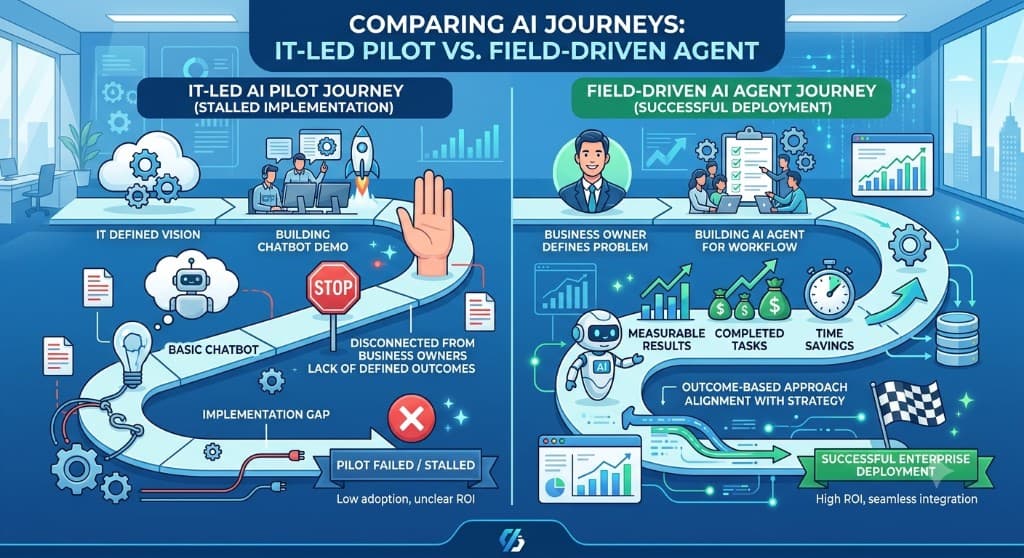
What changes when the business leads
| Traditional AI pilot | Business-led agent path |
|---|---|
| Owned by IT or vendor | Owned by the team that runs the process |
| Success = demo or chat volume | Success = completed work and time saved |
| Generic assistant for everyone | Custom agent for a defined workflow |
| Knowledge may be incomplete | Knowledge is curated around the process |
| Stops at advice | Continues into execution and handoffs |
| Needs specialist maintenance | Designed for business-led operation |
This path fits Japanese SMEs especially well because it respects how work already happens: domain experts know the rules, exceptions, and relationships. They should not have to wait for a large engineering program before automating routine steps.
A practical way to start
If your last AI pilot stalled, try a narrower path:
- Pick one painful, repeatable process — onboarding, invoice checks, IT triage, travel requests, customer follow-up.
- Name a business owner — someone who lives the process weekly.
- Define the finished outcome — not “answer questions,” but “request approved,” “ticket routed,” or “document reviewed and sent.”
- Ground the agent in company knowledge — policies, templates, SOPs, past examples.
- Add approvals and permissions early — so security is part of the design, not a blocker at the end.
- Measure cycle time and rework — before and after.
You do not need to automate the whole company. You need one process that proves AI can finish work, not just talk about it.
How a platform like WellSkate AI helps
This is exactly the gap a solution like WellSkate AI is built to close.
WellSkate AI gives SMEs and growing enterprises a secure way to build custom AI agents and Agentic Workflows without standing up a dedicated AI engineering team or separate infrastructure stack. Business teams can create agents grounded in their documents and processes, connect them to everyday workspaces, and operate under enterprise security and governance controls.
For Japanese companies that have already tried chatbot pilots, the shift is practical:
- From generic chat → process-specific agents
- From demo energy → measurable workflow outcomes
- From IT-only ownership → business-led build and operation
- From scattered knowledge → a searchable, usable knowledge layer
- From “AI might leak data” → permissions, policies, and controlled execution
WellSkate AI will not replace judgment, relationships, or complex exception handling. It helps teams automate the repeatable middle of the work — so people can spend more time on decisions that actually need a human.
The point is not more pilots
Japanese SMEs do not need endless AI experiments. They need a shorter path from idea to production: one owner, one process, one agent that uses company knowledge and completes real steps.
When the people who understand the work best can turn that understanding into secure automation, AI stops being a side project and starts becoming operating capacity.
Want to move a stalled pilot into a business-led agent? Explore WellSkate AI at wellskate.ai or contact contact@wellskate.ai.