
Build vs buy vs assemble for enterprise agents — cost, speed, governance trade-offs
Most enterprise AI debates still start in the wrong place. The question is not “which model is best?” It is how the company will own, operate, and govern agents in production.
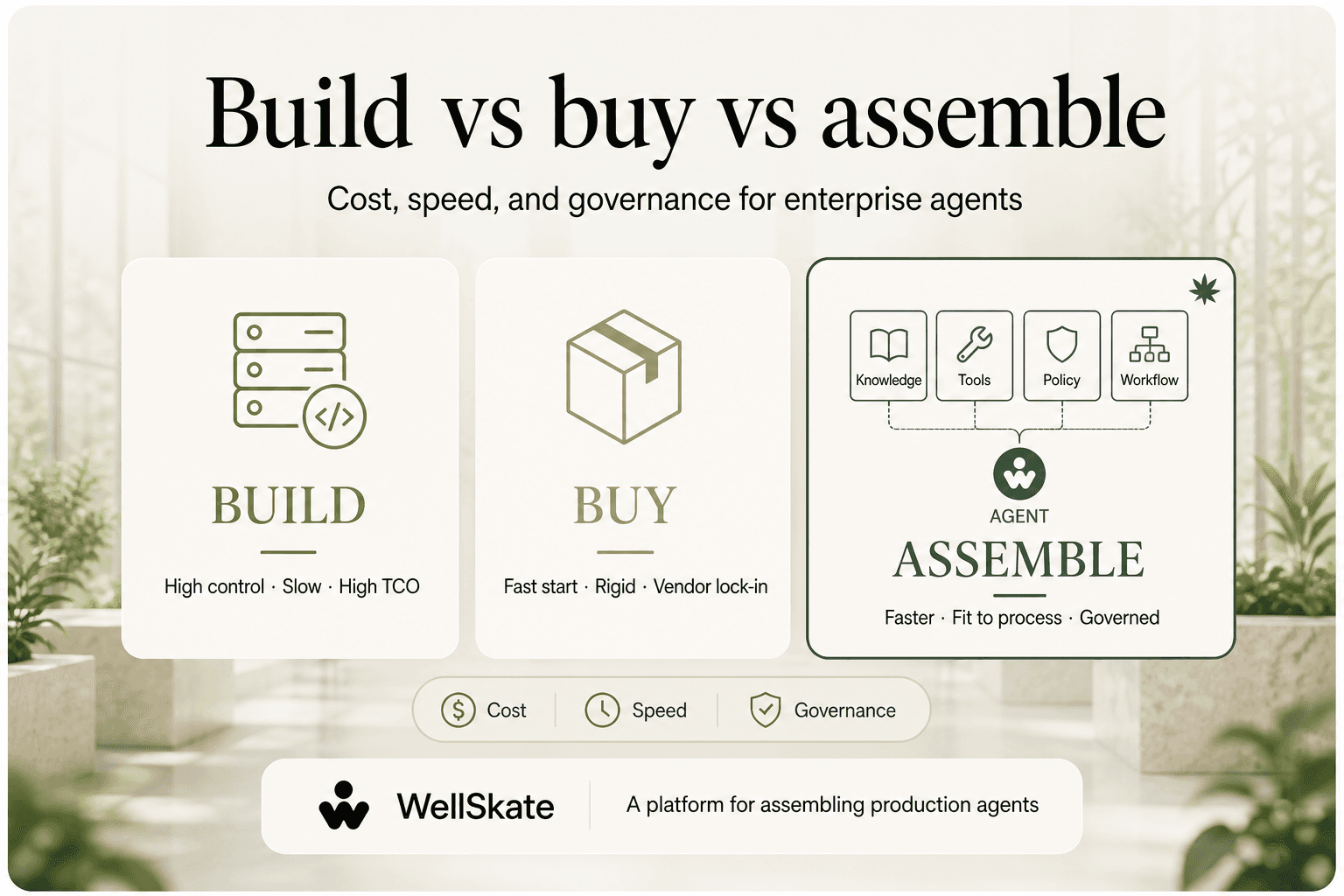
That choice usually collapses into three paths:
- Build — design the stack yourself: models, orchestration, connectors, evals, observability, and security.
- Buy — adopt a packaged agent or chatbot that already knows a category of work.
- Assemble — compose custom agents on a platform: your knowledge, your tools, your policies, your workflows.
All three can succeed. They fail for different reasons. Cost, speed, and governance do not move together — and treating them as one score is how pilots stall after the demo.
The three paths, in practice
Build
Build means your team owns the agent runtime. You pick models, write tools, wire identity, store traces, and keep the system alive as APIs change.
You get maximum control: unique logic, private infrastructure, custom evals, and no vendor product roadmap in the way.
You also inherit the full operating cost of an internal product. Model access is the cheap line item. Engineers, reviews, incident response, connector maintenance, and policy work are not.
Build is justified when the agent is the product — or when the workflow is so distinctive that a platform would fight you at every step.
Buy
Buy means a vendor ships a finished agent for a known job: IT helpdesk deflection, contract clause extraction, a CRM copilot, a meeting-notes bot.
Time-to-first-demo is excellent. The vendor has already made dozens of product decisions you would otherwise debate for months.
The trade-off is fit. Packaged agents encode someone else’s process. They are strong when your workflow matches the category, and weak when your approvals, systems of record, or exception paths are company-specific — which they usually are.
Buy is justified for commodity work where uniqueness is a liability, not an advantage.
Assemble
Assemble sits between the two. You do not write an agent platform. You also do not accept a black-box bot that cannot see your process.
You compose agents from pieces the platform already provides:
- Company knowledge, with existing permissions
- Connectors to chat, email, docs, and systems of record
- Policies, approvals, and audit trails
- Workflows that can run across steps, not just answer once
The job of the platform is the undifferentiated heavy lifting: identity, model routing, tool execution, logging, eval hooks, and admin controls. The job of the business team is to define the outcome, the exceptions, and the knowledge the agent needs.
That is the path most enterprises actually need for Agentic Workflows — custom enough to match how work happens, governed enough to survive security review, fast enough to reach production before the sponsor moves on.
Cost is total cost of ownership, not the license line
A cheap pilot can be an expensive operating model.
| Cost bucket | Build | Buy | Assemble |
|---|---|---|---|
| Upfront | High: design, infra, integrations, evals | Low–medium: license + setup | Medium: platform + first workflow |
| People | AI/platform engineers on the critical path | Vendor plus a business owner | Business owner + light IT/security |
| Integration | You build and maintain every connector | Vendor’s connectors, or none | Platform connectors, extended as needed |
| Change cost | Every process change is a sprint | Wait for the vendor, or work around it | Change the workflow, knowledge, or policy |
| Hidden cost | On-call, model churn, security reviews that never end | Shadow processes when the bot cannot finish the job | Under-scoping the first workflow |
The expensive failure mode for build is a platform that never leaves the lab: talented people maintaining scaffolding instead of shipping outcomes.
The expensive failure mode for buy is a second operating system. Employees still copy answers into Slack, Excel, and the system of record. You paid for advice, then paid humans to finish the work.
The expensive failure mode for assemble is treating the platform like a chatbot overlay — connecting nothing, governing nothing, and measuring chat volume. Assembly only pays off when the agent is aimed at a finished outcome.
A useful cost question is not “what does year-one software cost?” It is: who has to show up every time the process changes?
Speed is time to a trusted production workflow
Demos are not speed. Speed is the elapsed time until a real owner trusts the agent with real work.
Buy is fastest to a demo. If the packaged flow matches yours, it can also be fastest to production. If it does not, speed reverses: months of workarounds, field mapping, and “the bot doesn’t know our exception path.”
Build is slowest to first production, even with a strong team. Identity, tool sandboxing, prompt/version control, evals, and audit are not optional in an enterprise. Teams that skip them ship quickly and then freeze when security arrives.
Assemble is usually fastest to a trusted workflow — not because the software is magic, but because the platform already contains the parts security will ask for, and because the first unit of work can be one process instead of a platform program.
A practical speed test:
- Can a business owner describe “done” in one sentence?
- Can the agent use the knowledge and tools that path already needs?
- Can a human approve the steps that already require approval?
- Can you see what the agent accessed, proposed, and did?
- Can you change the workflow next month without a rebuild?
If the answer to (1) is yes and (2)–(4) take a quarter, you are building more than you think. If (5) requires the vendor’s roadmap, you bought more lock-in than you think.
Governance is not a phase after the pilot
Enterprises do not reject agents because the model is weak. They pause them because nobody can answer:
- Whose identity did the agent act under?
- What data did it see?
- Which policy applied?
- Who approved the external send, the ticket close, the record update?
- Can we reproduce last Tuesday’s run?
Build can reach the highest governance bar — if you staff it. Permissions, data boundaries, red-teaming, retention, and human checkpoints are products you must design. Many internal stacks look governed in architecture slides and leaky in the traces.
Buy inherits the vendor’s controls. That can be a feature: SOC reports, admin consoles, and retention settings arrive on day one. It can also be a ceiling: you cannot add the approval that your legal team requires, or you cannot keep data in the region your policy demands, or the agent can read more than the user who invoked it.
Assemble should make governance a default of the runtime, not a project:
- Permissions travel with the user and the document
- Policies constrain tools, not just prompts
- Approvals sit on the same path the team already uses
- Traces are available to security without a custom pipeline
If a platform cannot inherit access controls, it is not an assemble path. It is a parallel knowledge base with a chat window.
Governance also affects speed. Teams that postpone it do not go faster. They accumulate a freeze date. The cheapest time to add auditability is before the first department-wide rollout.
Put the three trade-offs on one page
| Build | Buy | Assemble | |
|---|---|---|---|
| Primary bet | Unique IP and full control | Category-best packaged workflow | Company-specific agents on shared infrastructure |
| Time to demo | Slow | Fast | Fast |
| Time to trusted production | Slowest | Fast if fit is high; slow if not | Fastest for most custom processes |
| Fit to your process | Highest | Lowest unless you are the category | High, if the platform can run multi-step work |
| Governance ceiling | Unlimited, if you build it | Vendor’s product | Platform’s controls + your policies |
| Lock-in | People and internal APIs | Vendor process and data | Platform, with portable knowledge and process definitions |
| Best owner | Platform / AI engineering | Business + vendor success | Business owner, with IT and security as partners |
| Failure mode | Platform never ships | Bot answers; humans still finish the job | Chat overlay with no outcome |
There is no universal winner. There is a default for enterprise agents that must complete work: assemble first, buy for commodity edges, build only where the agent is strategic differentiation.
When to choose each path
Choose build when
- The agent is the product, or a core capability customers pay for
- You already run a mature internal AI platform (identity, evals, observability, on-call)
- The workflow requires low-level control a product platform cannot expose
- You can fund the team after the first launch, not only during the prototype
Do not choose build because “we have engineers.” Engineers are the scarce resource. Spending them on undifferentiated orchestration is how agent programs stall.
Choose buy when
- The job is standard: FAQ deflection, meeting notes, generic CRM drafting
- Your process matching the vendor’s is an advantage (shared best practice)
- You need a result this quarter and the workflow is not a source of uniqueness
- Switching cost is acceptable if the vendor misses your edge cases
Do not choose buy for the process that makes your company distinct — onboarding, claims, underwriting, customer exceptions, internal approvals. Those encode judgment you should own.
Choose assemble when
- Business teams understand the work better than any vendor template
- Knowledge is scattered, and permissions already exist in Drive, chat, and systems of record
- The outcome spans tools and people: triage, prepare, route, approve, notify, record
- Security needs auditability, but you cannot wait for a two-year platform build
- You want custom agents without a dedicated AI engineering team for every change
That is most of the work enterprises now call “AI transformation.” It is not a chatbot. It is an Agentic Workflow assembled from knowledge, tools, and policy.
A decision sequence that avoids false precision
Skip the 40-row scoring matrix. Run this in order:
- Name the outcome — “invoice exception packet ready for approval,” not “finance AI.”
- Ask if the process is commodity — if yes, buy and measure deflection. If no, do not buy a generic bot and hope.
- Ask if the agent is the business — if yes, build. If no, do not start with infrastructure.
- Map the minimum assembly — knowledge sources, one collaboration surface, one system of record, the human checkpoints that already exist.
- Price the change loop — how often will policy, systems, or the happy path change in the next year? High change favors assemble over buy, and favors a platform over a custom runtime.
- Put governance on the first workflow — identity, permissions, traces, approvals. If a path cannot do this, it is not production-ready, however good the demo.
Then ship one workflow. Expand after it is trusted. Mixing paths is normal: buy meeting notes, assemble the onboarding agent, build the proprietary pricing brain. Mixing without a rule is how you get three stacks and no owners.
How WellSkate AI approaches this
WellSkate AI is built for the assemble path — on purpose. The people who understand the work best should turn that understanding into custom AI agents and Agentic Workflows, without standing up a model platform, a connector farm, or a governance program from scratch.
That is not a slogan. It is how the product is shaped against cost, speed, and governance.
Cost: business-led agents on shared infrastructure. Teams create and operate custom agents without specialized expertise. Dedicated AI engineers and a separate infrastructure stack are not on the critical path for every process change. Frontier models sit behind a single subscription, so model access is not a procurement project. You pay for a platform that already runs identity, execution, and admin — not for an internal agent OS.
Speed: a trusted workflow without migrating knowledge or moving people to a new console. Agents ground in the policies, documents, and process context the company already has. Contracts, reports, manuals, invoices, and SOPs become a searchable hub — you do not wait to build a clean-room knowledge graph. Agents join Slack, Teams, email, and the systems of record already in use, instead of asking employees to work in a parallel AI workplace. The first shippable unit is one Agentic Workflow: plan, coordinate, and complete multi-step work across teams and systems, with humans still on the approvals that already exist.
Governance: runtime, not a later program. Agents inherit the permissions of the person who triggered them. Policies govern what data can be accessed, processed, and shared, including scanning sensitive content before it reaches third-party models. Audit trails, escalation paths, and human oversight travel with the workflow. Security review does not have to invent a stack after the demo.
That combination is what makes assemble cheaper than build and more durable than buy. You are not purchasing someone else’s process. You are not financing an internal agent platform. You are assembling production agents around the work you already run.
If your last AI investment produced a demo, a license, and the same number of handoffs, the missing decision was not the model. It was the operating path.
Want to assemble a production agent around a real process? Explore WellSkate AI at wellskate.ai or contact contact@wellskate.ai.