
Agentic AI for finance — exceptions, approvals, and the monthly close
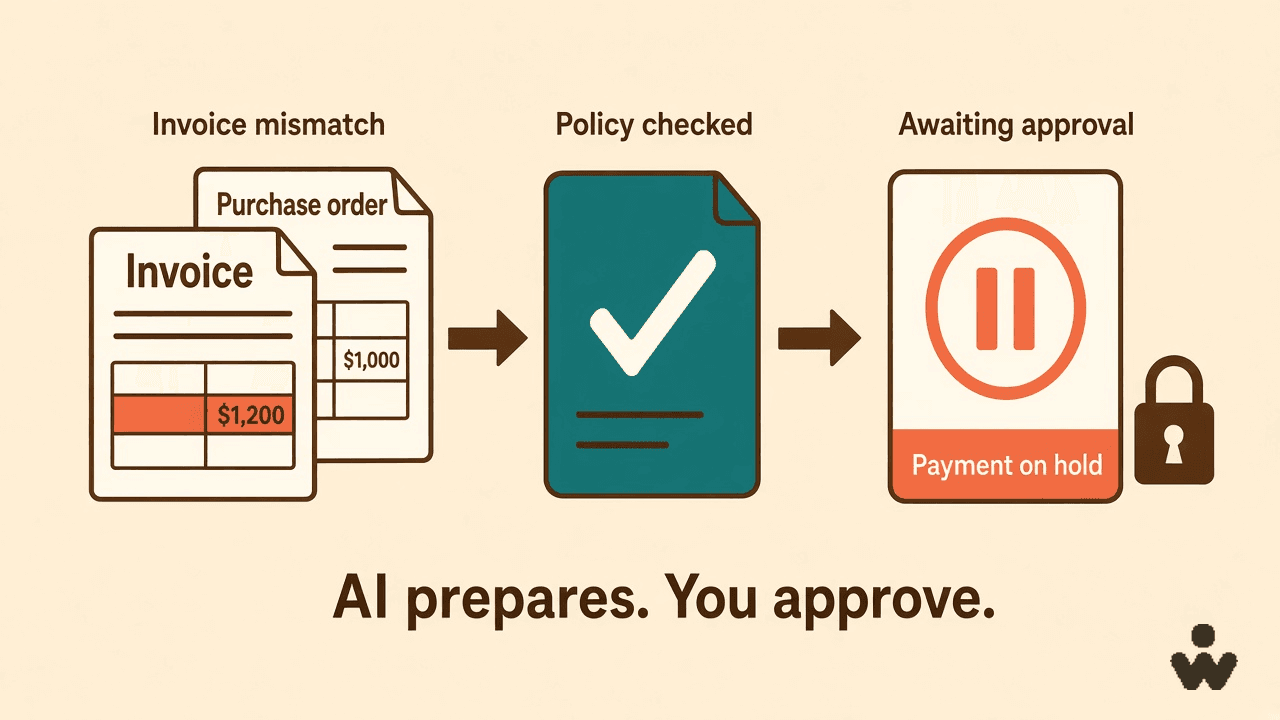
Most finance teams already use AI to draft the note about a late invoice. The work that still leaves the company is the exception.
A bill does not match the purchase order. The amount is off, the tax line is odd, or the vendor is new. Someone pastes the PDF, a slice of policy, and “what should I do?” into a personal chat, then copies the answer back into email. The close still happens. The company never sees the trail.
A chatbot can explain a policy page. Agentic AI reads the exception, cites the rule, drafts the question to the owner, and routes the approval — and stops before money moves.
The job is not “use AI in finance.” The job is to finish the exception, with a person still releasing the payment.
The paste finance already runs
In the last article we described the unofficial pilot: real work finishing in personal accounts while the official pilot is still a slide. Finance was one of the examples. The invoice that does not match gets settled the same way a sales follow-up does — outside the system that is supposed to hold it.
That paste has a shape you can name:
- The vendor bill
- The purchase order, contract, or receipt it should match
- The policy line someone remembers, or a screenshot of it
- The question: pay, hold, or ask
It is the same question every week. The answer depends on an amount, a vendor, and a rule the company already wrote. It does not depend on a new model. It depends on the document, the rule, and a named person when the rule says a person must decide.
What the agent finishes
Treat the exception as a short workflow, not a chat.
Read the mismatch. Amount, vendor, date, tax, purchase order, and what is missing. The agent should say which fields disagree, and quote the documents it used. A confident summary with no source is how a wrong payment starts.
Cite the rule. Company policy, the approval matrix, and the threshold that already exists: under this amount, this owner; over it, a second approver; a new vendor, an extra check. The agent applies the rule the company wrote. It does not invent a friendlier one.
Draft the question to the owner. The budget holder should see the mismatch, the rule, and a plain ask: approve, reject, or send back. That draft belongs in the tool finance already uses — Slack, Teams, or email — not in a side window. Connecting the agent to those tools is what makes the approved path faster than the personal account.
Leave a trail. What was read, which rule applied, who was asked, and what they decided. Month-end should be able to open that record without asking the person who remembers.
The useful output is a prepared exception: documents, the cited rule, a routed ask, and a record. It is not a payment that left on its own.
What stays with a person
Some steps are cheap to undo. A draft question is one of them. Releasing money is not.
Keep a person on anything that moves money or changes the rule:
- Releasing a payment
- Changing bank details or a vendor master record
- Agreeing a dispute with the vendor
- Overriding the policy, including “just this once”
- Signing the close
Human in the loop is the design of that stop, not a review after the payment has gone. The agent prepares. A named person decides the irreversible step. The record shows both.
A simple fence:
- The agent may read invoices, purchase orders, and approved policy
- The agent may draft the exception note and the question to the owner
- The agent may route that question where the team already works
- The agent may not pay, may not edit vendor bank details, and may not waive a threshold
The monthly close is the same exception, aged
Close week feels like a different job. It is mostly this one, piled up.
Unmatched bills, missing receipts, accruals waiting on one person’s memory, a spreadsheet named “close” that only two people can explain. The agent’s job at close is to assemble that pile into a pack a person can sign:
- Which items are still open
- Who owns each one
- Which rule applies, and whether the approval already happened
- What is blocked on a document the company does not have yet
The controller should not have to hunt chat logs to learn why an item is open. The pack should say it. A person still signs the close. The agent should not declare the books done.
Start with the exception that shows up every week. The close gets easier when that item no longer arrives as a surprise on day two.
Two weeks, one path
The last article’s test was simple: replace one recurring paste, then check whether that paste stopped. For finance, that paste is the invoice that does not match.
- Name the outcome. One vendor bill that does not match its purchase order, finished as an approved hold, an approved pay, or a send-back — with a record.
- Mark what must stay inside. Vendor, amount, bank details, and the policy. If those leave in a personal account, the trail leaves with them.
- Pick one owner. A person in finance who can say whether the paste stopped, not a committee that reviews a pilot slide.
- Put an approved agent on that path. Company documents, the approval matrix, and the tools the team already uses.
- Say the job may be done there. If the approved path is quiet and the personal account is fast, the paste continues.
- Check the paste, not the noise. The signal is completed exceptions inside the company, with a name on the payment decision. Fewer questions in the finance channel is not the metric if the work moved to a phone.
Teams that try to automate the whole close in week one rebuild the ledger inside a prompt. Teams that ship this one loop get a pattern the next exception can reuse: receipts, accruals, the new-vendor check.
How WellSkate AI approaches this
WellSkate AI is built for custom AI agents and Agentic Workflows on work finance already runs — invoices, policy, and approvals — without a separate engineering team for the exception path.
- Documents — agents read the bill, the purchase order, and the policy the company already approved
- The ask — agents draft the exception and route it in Slack, Teams, or email
- The stop — a named person stays on payment, vendor master changes, and any waiver
- The record — what was read, which rule applied, and who decided, on the same path as the work
The point is not to replace the controller. It is to stop using skilled finance people as the search layer between a PDF and a rule they already wrote.
If your team can draft the chasing email in seconds but still pastes the mismatched invoice into a personal account, you do not need a louder policy. You need an approved path that finishes that exception — and a person on the step that moves money.
Frequently asked questions
What should a finance agent finish on an invoice exception?
It should read the mismatch, cite the company rule and threshold, draft a plain question to the budget owner, route that question in Slack, Teams, or email, and leave a record of what was read and who decided. The useful output is a prepared exception, not a payment that left on its own.
What must a person still decide?
Releasing a payment, changing bank details or a vendor master record, agreeing a vendor dispute, waiving a threshold, and signing the close. The agent prepares those steps. A named person decides them.
How is this different from drafting a chasing email?
A draft email still leaves someone to find the purchase order, remember the policy, and paste the answer back. An agentic path finishes that loop: documents, the cited rule, a routed approval, and a trail month-end can open.
Where should finance start?
One recurring paste: the vendor bill that does not match its purchase order. Give it an owner, an approved agent, and two weeks. Check whether that paste stopped. Receipts, accruals, and the new-vendor check can reuse the same pattern after this one ships.
Does the monthly close need a separate agent?
Close week is mostly the same exceptions, aged. The agent assembles the open items, the owner, the rule, and what is still blocked. A person signs the close. Start with the weekly mismatch so day two of close is not the first time anyone sees it.
Want an approved agent on the invoice exception your team already finishes by hand? Explore WellSkate AI at wellskate.ai or contact contact@wellskate.ai.