
How Small Teams Can Build an AI-First Workflow
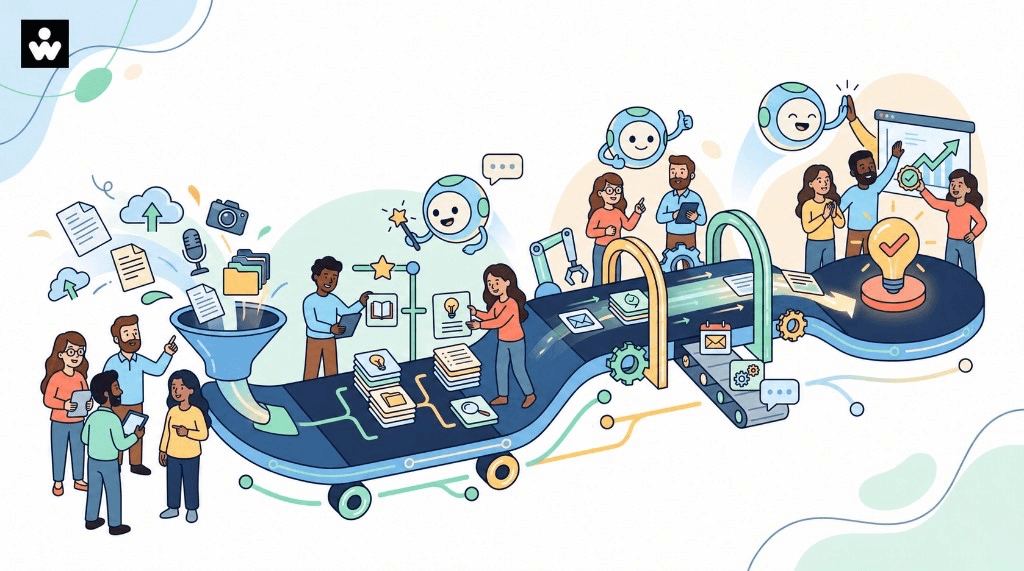
Many companies are investing in artificial intelligence and still not seeing consistent business results. The problem is often not a lack of AI tools. It is the lack of a clear, practical workflow for using them.
An AI-first workflow is a way of organizing work so that artificial intelligence supports information capture, knowledge management, routine tasks, and decision-making, while people remain responsible for judgment and accountability.
The most effective AI strategy is not to use the greatest number of tools. It is to integrate the right capabilities into the workflows your team already uses.
Integrate the right capabilities into the workflows your team already uses. More tools are not the strategy.
Key takeaway
- An AI-first workflow uses AI for capture, knowledge, routine work, and decision support, while people keep judgment and accountability.
- Start with one frequent, measurable task where a person can catch mistakes before they cause harm.
- A 30-day pilot is enough to test one workflow against a baseline and decide whether to refine it or choose a better use case.
What is an AI-first workflow?
An AI-first workflow is a business process designed from the beginning to use AI where it can improve speed, quality, consistency, or access to information.
This does not mean removing people from the process. In most organizations, AI works best as a copilot: it prepares information, identifies patterns, generates drafts, or recommends next steps, while a person reviews important outputs and makes the final decision.
A well-designed AI workflow has four characteristics:
- It solves a clearly defined business problem.
- It fits naturally into employees’ existing work.
- It includes human review where judgment matters.
- It has measurable goals and safeguards.
Why AI initiatives often fail
AI pilots frequently fail because organizations adopt technology before understanding the workflow it is supposed to improve.
The tool comes before the problem
A popular AI application may be impressive, but it is not automatically useful for every team. Start by identifying where the organization is losing time, quality, revenue, or insight.
AI is added without redesigning the process
Adding an AI-generated draft to a slow process may save only a few minutes. The larger opportunity may be reducing manual data collection, eliminating duplicate entry, or improving the handoff between teams.
No one owns the outcome
Every AI initiative needs a clear owner who is responsible for the business result, not merely for launching the technology.
Employee adoption is overlooked
People are less likely to use AI when they do not understand how it works, what it can be trusted to do, or how it affects their responsibilities. Successful adoption requires practical examples, training, feedback, and clear boundaries.
The four layers of an AI workflow
A strong AI workflow usually develops across four connected layers. Each layer makes the next one more useful. None of them replaces the person who owns the outcome.
- 1
Capture information
Turn meetings, conversations, requests, and operational activity into structured knowledge.
- 2
Organize knowledge
Connect related work, surface earlier decisions, and keep authoritative sources clear.
- 3
Automate repetitive work
Draft, classify, extract, and route frequent tasks a person can still review.
- 4
Support better decisions
Compare options and summarize evidence. A person still makes the decision.
People remain accountable for judgment and outcomes.
1. Capture information
Businesses generate useful information through meetings, customer conversations, support requests, research, internal messages, and operational activity. That information is often scattered across systems and difficult to reuse.
AI can help transcribe, summarize, classify, tag, and structure information so that it becomes easier to find and act on.
The goal is not to create more documents. The goal is to make important knowledge available when people need it.
2. Organize knowledge
Captured information becomes more valuable when it has context.
AI can help teams identify themes, connect related documents, surface previous decisions, and make internal knowledge searchable using natural language. This reduces the time employees spend searching for answers or asking questions that have already been answered.
Organizations should still establish clear rules about which sources are authoritative and how outdated information is handled.
3. Automate repetitive work
Routine tasks are often the best starting point for AI workflow automation. Good candidates are frequent, rules-based, and easy for a person to review.
Examples include:
- Drafting routine emails and documents
- Summarizing meetings and creating action items
- Categorizing incoming requests
- Extracting information from forms and documents
- Preparing recurring reports
- Generating internal status updates
- Routing questions to the appropriate team
A human-in-the-loop approach is often the safest and most effective design. AI prepares or prioritizes the work, while a person reviews and approves it.
4. Support better decisions
AI can help teams compare options, identify patterns, summarize evidence, and explore possible scenarios.
Decision support must not become a substitute for accountability. People should remain responsible for decisions involving customers, employees, finances, safety, compliance, or other high-impact outcomes.
How to choose the best AI use case
The best AI use case is not necessarily the most ambitious one. It is usually a workflow where the potential value is clear, the risks are manageable, and success can be measured.
Use the following questions to evaluate a possible use case.
Does the task happen frequently?
A task performed hundreds of times per month may offer meaningful savings even if each individual improvement is small.
Are the inputs and outputs clear?
Teams should be able to explain what information goes into the process and what a useful result looks like.
Can mistakes be detected and corrected?
Early AI projects should avoid irreversible decisions. Begin with workflows where human review can catch errors before they cause significant harm.
Do employees understand the process?
The people who perform the work every day can often identify the most valuable improvements. Involving them also improves adoption.
Can results be measured?
Define a baseline before starting. Useful metrics may include:
- Time saved per task
- Response time
- Error rate
- Completion rate
- Customer satisfaction
- Employee satisfaction
- Cost per transaction
- Revenue generated or protected
What should humans continue to do?
AI can process information and generate outputs quickly, but it does not eliminate the need for human judgment.
People remain essential for:
- Understanding context
- Making ethical judgments
- Managing sensitive relationships
- Handling ambiguity
- Taking responsibility for outcomes
- Setting strategy and priorities
The purpose of AI productivity is not simply to make people work faster. It is to reduce low-value effort so people can spend more time on work that requires reasoning, empathy, creativity, and leadership.
A 30-day plan for adopting AI
Organizations can begin with a focused pilot instead of attempting a company-wide transformation.
Week 1: Identify a bottleneck
Speak with employees and document repetitive tasks, slow handoffs, duplicate work, manual data entry, and information that is difficult to find.
Choose one workflow with a clear owner and a measurable outcome.
Week 2: Design the smallest useful pilot
Map the current process from beginning to end. Decide where AI can assist and where human review must remain.
Start with one meaningful improvement, such as summarizing incoming information, preparing a first draft, or classifying requests.
Define success metrics and safeguards before launching the pilot.
Week 3: Test with real work
Use realistic examples rather than idealized test data. Ask employees to record where the system saves time, where it creates extra work, and where its output is unreliable.
Small points of friction often determine whether a workflow succeeds in practice.
Week 4: Measure and improve
Compare the pilot with the original baseline. Did the process become faster? Did quality improve? Did employees find the workflow easier to use? Did customers experience better service?
If the pilot works, refine it before expanding. If it does not, use the findings to select a better use case.
Responsible AI adoption for businesses
AI adoption is also a trust and governance challenge. Employees need to know how AI is being used, what information it can access, and when a human must review its output.
A practical responsible AI policy should include the following principles:
- Protect confidential and sensitive information.
- Keep humans accountable for high-impact decisions.
- Verify important AI-generated outputs.
- Document AI use in critical workflows.
- Monitor performance after deployment.
- Give employees a way to report problems.
- Update workflows when business or regulatory requirements change.
Good governance should support experimentation without allowing preventable risks to go unnoticed.
The real advantage of AI
AI tools will continue to change quickly. Individual features may become standard, and new applications will continue to appear.
A lasting advantage comes from something more durable: the ability to turn AI into reliable, repeatable ways of working.
That requires clear objectives, useful information, thoughtful process design, employee participation, measurable outcomes, and responsible oversight.
The strongest AI-enabled organizations will not automate every possible task. They will understand where AI creates leverage and where human judgment should remain at the center.
The companies that benefit most will be those that integrate AI most thoughtfully into the way their people already work.
WellSkate AI is a secure enterprise platform for custom AI agents and Agentic Workflows. Teams can ground that work in their own knowledge, connect the tools they already use, and keep a person on the steps that require judgment. The four layers above can live in one governed workflow instead of four disconnected tools.
For a closer look at where people should stay in the loop, see human-in-the-loop design for enterprise AI. To judge a project by business results rather than AI activity, see when AI becomes the work.
Frequently asked questions
What is an AI-first workflow?
An AI-first workflow is a business process designed to use AI wherever it can improve efficiency, quality, access to information, or decision support, while keeping people responsible for important judgments and outcomes.
What is the best place to start with AI automation?
Start with a frequent, repetitive, measurable task where errors can be detected through human review. Examples include meeting summaries, document extraction, routine reporting, and request classification.
Does an AI-first workflow replace employees?
In many cases, AI removes repetitive work and allows employees to focus on judgment, creativity, customer relationships, and strategic work. The effect depends on how the organization designs and manages the workflow.
How can a company measure AI productivity?
Establish a baseline and track metrics such as time saved, response time, error rate, output quality, customer satisfaction, employee satisfaction, and cost per transaction.
What are the main risks of using AI at work?
Common risks include inaccurate outputs, privacy breaches, biased recommendations, weak oversight, unclear accountability, and employee overreliance on automated results. Human review, access controls, documentation, and ongoing monitoring can reduce these risks.
How quickly can a business adopt AI?
A focused pilot can often be designed and evaluated within 30 days. Broader adoption takes longer because it requires workflow refinement, employee training, governance, and integration with existing systems.
Explore how WellSkate AI can help your team build practical AI workflows at wellskate.ai, or contact contact@wellskate.ai.