
HR agent — policies, onboarding, and approvals without a helpdesk bottleneck
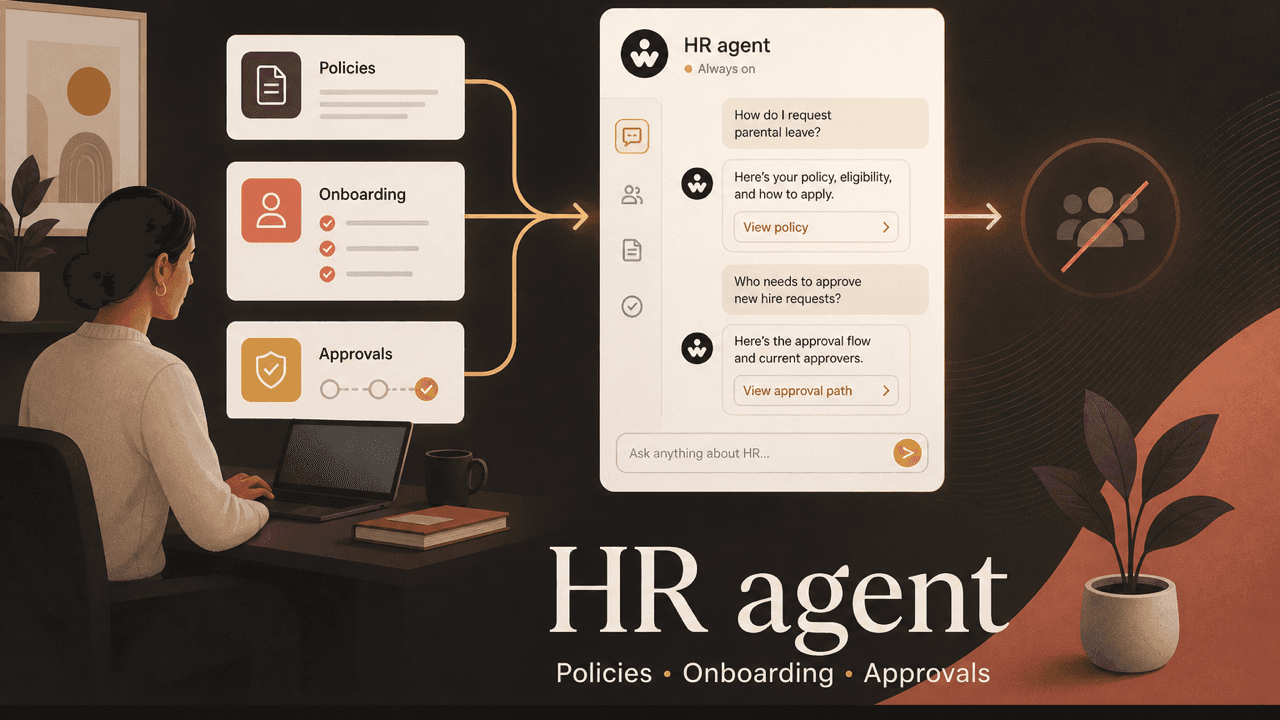
HR teams do not have a chatbot problem. They have a throughput problem.
Most companies already document the repetitive work. Handbooks, how-to pages, onboarding checklists, and approval guides exist so employees can self-serve. In practice, the same requests still land in Slack, email, and a ticket queue: “Can I work from overseas next month?”, “What do I need before day one?”, “Who still needs to approve this leave?”
Someone in People Ops opens the doc the company already wrote, pastes the relevant section, chases a manager, updates a spreadsheet, and closes the ticket. Then the next identical request arrives.
That is not a missing-wiki problem. It is a helpdesk bottleneck: documentation explains the path, but HR still has to find it, apply it, and finish the steps that docs cannot complete alone. An HR agent is useful when it does more than point at a page — when it can ground in that documentation, run onboarding steps, and move approvals without making People Ops the human search layer for every hop.
Why the helpdesk becomes the bottleneck
HR portals, FAQs, and internal docs reduce some lookups. They rarely remove the queue. Employees still ask because the right page is hard to find, hard to trust for their case, or stops before the work is done.
Three forces keep volume high:
- Policy and how-tos are scattered — handbooks, side letters, regional PDFs, Confluence pages, Slack threads that contradict the PDF
- Onboarding is multi-system — accounts, equipment, training, introductions, and paperwork rarely live in one tool, even when a checklist PDF exists
- Approvals are social — the hard part is not the form or the guide; it is nudging the right person with the right context
A human helpdesk absorbs all three — often by re-explaining documentation that already exists. That is expensive, and it does not scale when headcount, locations, or policy complexity grow.
A chatbot bolted onto the handbook helps with (1) some of the time. It usually does nothing for (2) and (3). Employees still open tickets to get the rest done.
What an HR agent is (and is not)
An HR agent is not a friendlier search box. It is a governed worker aimed at HR outcomes.
| HR FAQ chatbot | HR agent | |
|---|---|---|
| Primary job | Answer policy questions | Complete HR work |
| Unit of value | A reply | A finished outcome |
| Onboarding | Points to a checklist | Runs and tracks the checklist across tools |
| Approvals | Explains who should approve | Routes, reminds, escalates, records the decision |
| Systems | Often read-only docs | Knowledge + HRIS/IT/chat/email as needed |
| Human role | Still does every follow-up | Handles exceptions and sensitive judgment |
The useful test is simple: If the AI disappeared after sending a message, would the employee still be stuck? If yes, you need an agentic flow — not another FAQ surface.
Policies: answers people can trust
Policy Q&A fails when the answer is plausible but wrong for this employee.
A production HR agent should:
- Ground replies in the current handbook, benefit guides, and regional addenda — not a stale snapshot
- Respect permissions (offer letters and performance notes stay out of general answers)
- Name the source (“Parental leave, JP handbook §4.2”) so HR can audit and employees can verify
- Detect when the question needs a person: grievances, accommodations, edge cases, or conflicting documents
That last point matters. Deflection is not the goal. Correct routing is. The agent should clear the repeatable lookups and escalate the cases that need judgment — with the context already attached.
Done well, policy work stops being “open a ticket so someone pastes section 3.” It becomes a self-serve answer with a paper trail, and a short queue for what only humans should decide.
Onboarding: one outcome, many steps
Onboarding is where chatbots look helpful and then stall. The new hire does not need another PDF. They need accounts provisioned, equipment ordered, training assigned, a buddy introduced, and day-one access confirmed.
An Agentic Workflow for onboarding looks closer to this:
- Trigger from signed offer or start date in the HRIS
- Collect missing details from the hire or hiring manager
- Create or request IT accounts under existing identity rules
- Assign compliance and role training
- Schedule intro meetings and send the right welcome pack
- Track blockers; escalate only the steps that are late or failed
- Confirm “ready for day one” to the manager — not a pile of unchecked boxes
HR’s role shifts from chasing every checkbox to owning exceptions: visa delays, custom tooling, sensitive role requirements. The agent owns the happy path and the reminders.
That is how you remove the bottleneck without pretending onboarding is a single FAQ.
Approvals: stop making HR the messenger
Leave, expenses adjacent to policy, remote-work exceptions, role changes — most of these already have an approver. The bottleneck is coordination:
- The request sits unread
- The approver lacks context
- HR pings, then pings again
- Nobody can see where the request actually is
An HR agent should sit on the path work already uses:
- Draft or validate the request against policy before it is submitted
- Route to the right manager or committee with the policy excerpt attached
- Remind on the team’s existing channel (Slack, Teams, email) — not a forgotten portal
- Escalate after a defined SLA
- Write the decision back to the system of record and notify the requester
HR still designs the policy and the exception path. They should not have to be the human API between every employee and every manager.
Governance is the product, not a phase
HR data is among the most sensitive in the company. An agent that “mostly works” in a pilot can still be unacceptable in production.
Minimum bar:
- Identity — the agent acts with the permissions of the user (or a clearly scoped service role), not an open vault of everyone’s files
- Policy on tools — what it may read, draft, send, or update is constrained beyond the prompt
- Human checkpoints — terminations, investigations, compensation changes, and similar actions stay behind approval
- Audit — who asked, what sources were used, what was proposed, who approved, what changed
- Escalation — clear handoff to People Ops / Legal / IT with context preserved
If your HR agent cannot explain last Tuesday’s leave approval, it is not ready for company-wide use — however good the demo answers sounded.
A practical starting sequence
Do not begin with “HR AI.” Begin with one outcome.
- Pick the highest-volume, lowest-judgment loop — usually policy lookup plus one approval type, or preboarding for a single country
- Map the real path — docs, HRIS fields, chat surfaces, and the humans who already approve
- Define “done” — “employee has a sourced policy answer” or “leave request decided and recorded,” not “chat sessions”
- Put governance on day one — permissions, traces, escalation
- Measure queue time and reopen rate — not only deflection percentage
- Expand only after trust — onboarding is a strong second wave once policy and approvals are reliable
Teams that try to automate all of People Ops on week one recreate the helpdesk inside a prompt. Teams that ship one finished loop create capacity — and a pattern the next workflow can reuse.
How WellSkate AI approaches this
WellSkate AI is built for custom AI agents and Agentic Workflows on work HR already runs — without standing up a separate AI engineering program for every process.
- Policies — agents ground in the handbooks and process docs the company already has, with permissions that travel with the user and the document
- Onboarding — multi-step workflows can plan, coordinate, and complete work across chat, email, and systems of record, instead of stopping at advice
- Approvals — human checkpoints sit on the same path the team already uses; audit trails travel with the run
- Governance — sensitive content controls, inherited access, and oversight are part of the runtime, not a project after the pilot
The point is not to replace People Ops. It is to stop using skilled HR practitioners as a search engine, a checklist runner, and a reminder bot.
If your HR queue is full of questions the handbook already answers, onboarding steps that stall between systems, and approvals that wait on the next ping, you do not need a thicker FAQ. You need an HR agent aimed at finished outcomes.
Want to assemble an HR agent around a real policy, onboarding, or approval path? Explore WellSkate AI at wellskate.ai or contact contact@wellskate.ai.