
Beyond Basic RAG: How Enterprise AI Agents Turn Knowledge into Action
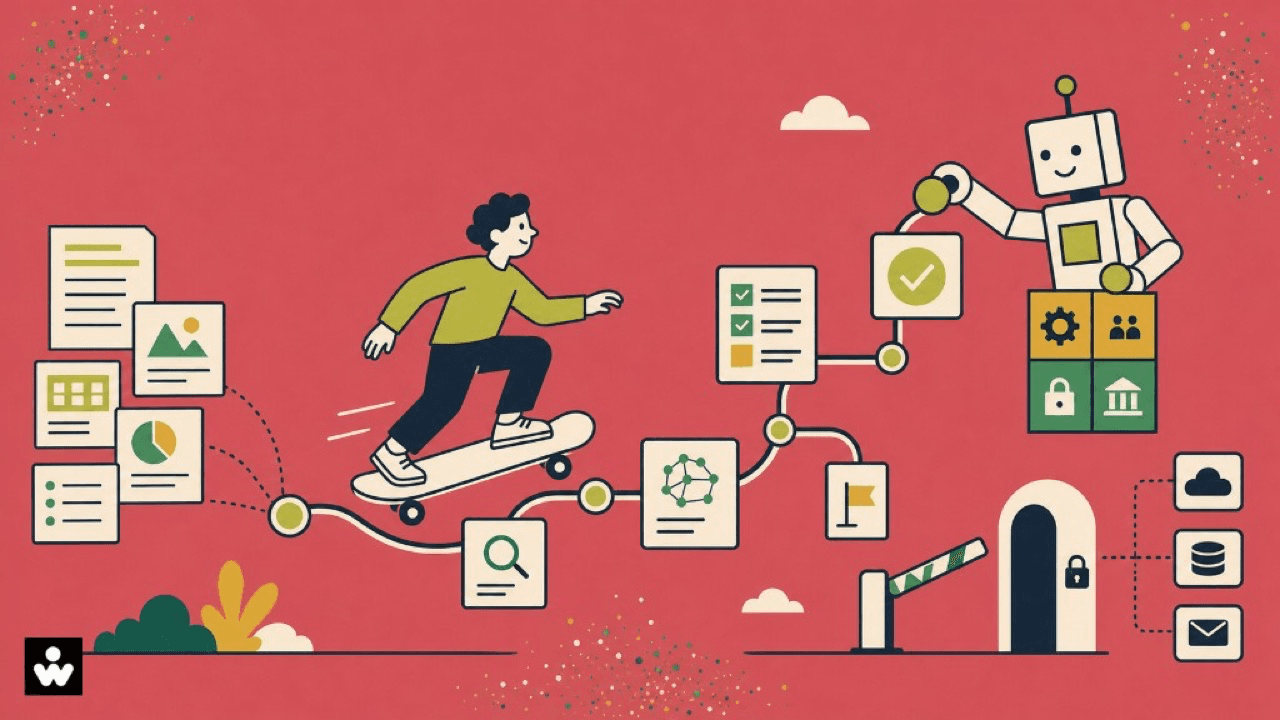
Retrieval-augmented generation (RAG) has become one of the most practical ways for organizations to use generative AI. It connects an AI model to company documents, knowledge bases, websites, databases, and other business information so the model can generate answers grounded in current, relevant sources.
RAG made it possible to build internal knowledge assistants, customer-support tools, policy search systems, and document-analysis applications without training a foundation model from scratch.
But enterprise AI is moving beyond document search.
Businesses increasingly want AI systems that can understand context, apply business rules, use approved tools, make recommendations, and help complete real workflows. That shift—from retrieval to action—is where enterprise AI agents become valuable.
RAG may be the “daddy” of enterprise AI retrieval, but modern business systems need more than search. They need context, reasoning, tools, workflows, and governance.
Key takeaway
- RAG grounds AI answers in company knowledge, but retrieval alone rarely finishes a business process.
- Enterprise AI agents extend RAG with context, reasoning, tools, permissions, approvals, and workflows.
- Choose architecture by the outcome: look up information with RAG; complete multi-step work with a governed agent.
What is RAG?
Retrieval-augmented generation is an AI architecture that retrieves relevant information from one or more sources and provides that information to a language model before it generates a response.
A basic RAG workflow usually looks like this:
- A user submits a question.
- The system searches one or more knowledge sources.
- Relevant documents or text passages are retrieved.
- The AI model uses that context to generate an answer.
RAG can improve relevance, reduce dependence on a model’s training data, and connect AI applications to an organization’s proprietary knowledge.
Common enterprise RAG use cases include:
- Searching internal policies and procedures
- Supporting customer-service representatives
- Summarizing reports, manuals, and contracts
- Retrieving product and technical information
- Answering questions about HR, finance, legal, or compliance content
- Grounding responses in an organization’s approved sources
RAG is an important foundation. However, retrieval is only one part of most business processes.
Why basic RAG is not enough for every enterprise use case
Consider an employee asking:
“Can I claim this expense, and what do I need to submit?”
A basic RAG assistant may retrieve the expense policy and explain the relevant rule. That is useful, but the employee may still need to check the amount, identify the correct form, gather missing information, and send the request to the right manager.
The business opportunity is not only to answer the question. It is to help move the process forward safely and efficiently.
1. Retrieved information may lack context
A search result can appear relevant while omitting definitions, exceptions, or surrounding sections that change the meaning of a policy.
For example, an expense policy may have different rules for departments, employment types, countries, spending categories, or approval thresholds. Retrieving a single paragraph may produce an incomplete or misleading answer.
2. Enterprise sources may conflict
Organizations often have duplicate documents, outdated guidance, local exceptions, and multiple versions of the same policy. An enterprise AI system must identify authoritative sources and determine which information applies to the user’s situation.
3. Search does not automatically create action
A RAG system may provide the correct answer and still leave the user to complete the next step manually. Without integrations, it cannot update a CRM, create a ticket, submit an approval request, or write to an internal database.
4. Permissions are part of accuracy
Enterprise knowledge is not one open library. Users have different roles, locations, departments, and access rights. A trustworthy AI system must enforce existing permissions and avoid revealing information that a user is not authorized to access.
5. Reliability requires ongoing evaluation
An AI assistant should not be considered reliable simply because it works in a demonstration. Organizations need to evaluate retrieval quality, answer completeness, citation accuracy, policy compliance, tool use, and behavior as documents, models, and workflows change.
How enterprise AI is evolving beyond basic RAG
The answer is not usually to abandon RAG. A stronger approach is to extend it with better retrieval, richer context, reasoning, integrations, and governance.
Hybrid RAG
Hybrid RAG combines semantic search with keyword search, metadata filters, and reranking. Semantic search helps identify content by meaning, while keyword search is useful for exact terms.
Hybrid retrieval is especially valuable for:
- Product codes
- Legal clauses
- Error messages
- Policy names
- Customer or case identifiers
- Technical terminology
Context-aware retrieval
Documents are often divided into smaller chunks so they can be searched efficiently. However, a small chunk can lose important meaning when separated from its document, section, or surrounding content.
Context-aware retrieval adds information such as the document title, section hierarchy, topic, source date, business unit, or neighboring content. This helps the model interpret retrieved material more accurately.
GraphRAG
GraphRAG emphasizes relationships between entities and events. Instead of treating documents as isolated text, a graph-based system can represent connections between people, companies, products, projects, policies, and outcomes.
Graph-based retrieval can help answer questions such as:
- How are these organizations connected?
- Which projects depend on this supplier?
- What events contributed to this outcome?
- Which policies apply to this business unit?
GraphRAG is not necessary for every use case. It is most useful when relationships across multiple sources are central to the task.
Agentic RAG
Agentic RAG enables an AI system to plan and perform multiple retrieval steps instead of searching once and immediately generating an answer.
An agentic system may:
- Break a complex request into smaller questions.
- Select the most appropriate data source for each question.
- Search multiple times.
- Compare evidence from different sources.
- Check whether the available evidence is sufficient.
- Ask for clarification when important information is missing.
- Provide an answer, recommendation, or controlled next action.
This approach is better suited to research, analysis, and multi-step business tasks than a simple question-and-answer chatbot.
Long-context processing
Some tasks are better handled by providing a model with a large amount of source material directly. This can be useful when a user needs to compare a few long reports, review a contract, or analyze a complete project file.
Long-context processing does not eliminate the need for RAG. The best approach depends on the amount of information, cost, speed, access requirements, and the complexity of the task.
From answering questions to completing work
The central distinction is between an AI assistant that answers a question and an enterprise AI agent that helps complete a task.
Return to the expense example. A basic RAG assistant might find the travel policy and summarize it. An enterprise AI agent could:
- Read the employee’s expense request.
- Retrieve the relevant travel and expense policies.
- Check the date, amount, category, location, and employee role.
- Determine whether an exception applies.
- Ask for missing information.
- Prepare an approval request.
- Route it to the appropriate manager.
- Record the outcome in the correct system.
Retrieval remains essential. The agent still needs reliable policy information. The difference is that retrieval becomes one controlled component of a larger workflow.
What a business-ready enterprise AI agent needs
A reliable enterprise AI agent usually combines the following capabilities.
Knowledge retrieval
The agent needs access to relevant, current, reliable, and governed information. Source quality and source authority matter as much as search relevance.
Context and task state
The agent must understand the user’s request, prior steps, current task, relevant business conditions, and information already provided. Context helps prevent repetitive questions and incorrect assumptions.
Business rules
The agent should apply explicit organizational policies and decision rules rather than generate plausible but unsupported text.
Tools and integrations
The agent may need to access a CRM, ticketing system, project platform, database, communication tool, ERP, or internal API. Integrations allow the agent to use information and take approved actions within business systems.
Workflow actions
A useful agent can prepare, route, update, notify, recommend, or request approval—not merely explain what a user should do.
Permissions and human approval
High-impact or sensitive actions may require user confirmation, manager approval, separation of duties, or additional controls before execution.
Monitoring and evaluation
Organizations need visibility into what agents do, where they fail, how often users correct them, and how behavior changes as data, tools, and models evolve.
RAG vs. enterprise AI agents
RAG and enterprise AI agents are not competing concepts. RAG is primarily a method for grounding an AI system in relevant information. An enterprise AI agent is a broader system that can combine retrieval with reasoning, tools, rules, and workflow execution.
The right architecture depends on the task. A knowledge assistant may be sufficient for low-risk information retrieval. A multi-step process involving sensitive data or business systems may require an agent with stronger controls.
How to choose the right architecture
The most useful question is not:
“Should we use RAG?”
A better question is:
“What does the user need to accomplish, and what combination of knowledge, reasoning, tools, and controls will help them do it safely?”
Use a basic RAG experience when the primary need is to find and explain information. Consider a more advanced agent architecture when the task requires multiple sources, user-specific context, business rules, tool use, approvals, or changes to business systems.
A practical evaluation should consider:
- The risk of an incorrect answer or action
- The number and quality of available data sources
- Whether information changes frequently
- Whether the task requires exact terms or semantic understanding
- Which systems the agent must access
- What actions require confirmation or approval
- How performance will be measured
- How access, auditability, and data protection will be maintained
The WellSkate AI perspective
For many organizations, the challenge is not a lack of interest in AI. It is the complexity of turning AI capabilities into secure, useful business systems.
Teams may need to connect company knowledge, business rules, external tools, approval steps, and department-specific processes. They may also need to do this without building and maintaining an AI infrastructure stack from the ground up.
WellSkate AI is designed to support this transition—from isolated AI experiments and document-based chatbots to customized enterprise AI agents and workflows.
The goal is not to force every organization into the same architecture. One department may benefit from a knowledge assistant. Another may need an agent that connects to internal systems and automates a multi-step process.
A flexible enterprise AI platform should make it easier to create, configure, govern, evaluate, and improve these experiences as business needs evolve.
RAG is the foundation—not the destination
RAG remains an important foundation for enterprise AI. It helps organizations connect AI models to their own knowledge and reduce the distance between a user’s question and the information needed to answer it.
But retrieval alone is not the final destination.
The next generation of enterprise AI will combine retrieval with context, reasoning, tools, business rules, permissions, approvals, and workflows. It will not only tell employees where to find an answer. It will help them understand what to do next and, where appropriate, help complete the work.
For organizations evaluating their AI strategy, the path forward is not necessarily to replace RAG. It is to move beyond basic RAG and build systems that are more context-aware, more actionable, and more closely connected to the way the business operates.
The future of enterprise AI is not just about finding knowledge. It is about turning knowledge into responsible action.
Frequently asked questions
What is the difference between RAG and an AI agent?
RAG is a technique for retrieving relevant information and using it to ground an AI response. An AI agent is a broader system that can combine retrieval with context, reasoning, business rules, tools, and workflow actions.
Is RAG still relevant for enterprise AI?
Yes. RAG remains one of the most useful ways to connect AI models to an organization’s private and changing knowledge. Enterprise AI agents often use RAG as one component of a larger architecture.
What is agentic RAG?
Agentic RAG is an approach in which an AI system plans and performs multiple retrieval steps. It may select different sources, compare evidence, check whether information is sufficient, ask follow-up questions, and then produce an answer or initiate an approved action.
When should a business use an enterprise AI agent?
An enterprise AI agent is most useful when a task requires more than finding information—for example, applying business rules, checking user-specific context, interacting with multiple systems, requesting approval, or completing a multi-step workflow.
How can enterprise AI agents be governed?
Governance typically includes permission-aware retrieval, least-privilege tool access, human approval for high-impact actions, audit logs, monitoring, evaluation datasets, source management, and clear escalation paths when the agent is uncertain.
Can WellSkate AI support both RAG and AI workflows?
WellSkate AI is designed to help organizations create secure, customized AI agents and workflows that connect business knowledge, rules, tools, and approvals. The appropriate configuration depends on the organization’s use case, data, systems, and governance requirements.
Ready to move from AI-powered search to business-ready AI agents? Explore WellSkate AI at wellskate.ai or contact contact@wellskate.ai.