
Agentic Workflow vs chatbot — what’s the difference?
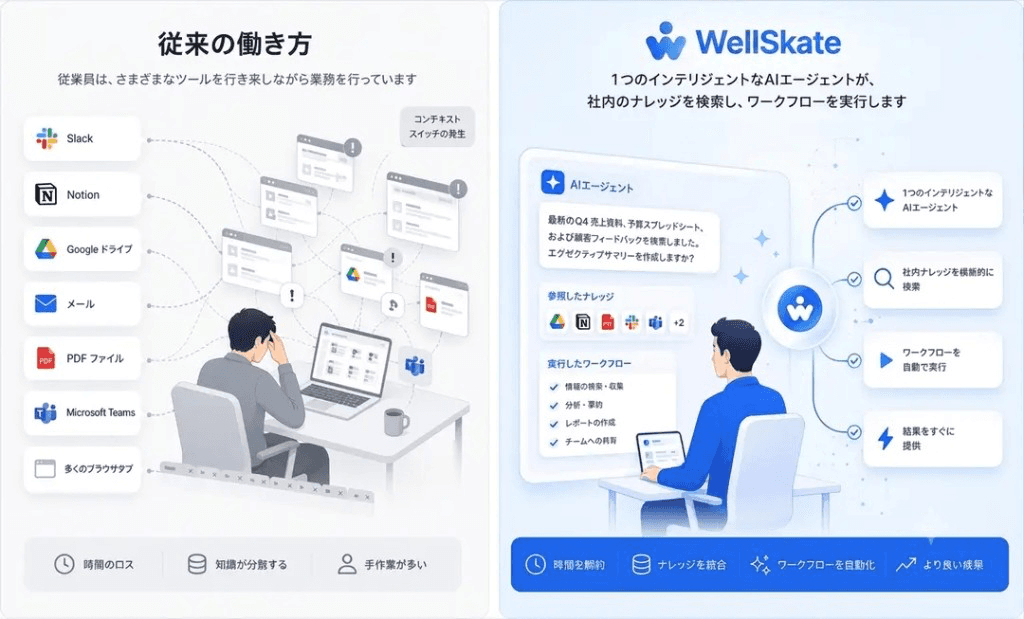
Many teams start their AI journey with a chatbot. That’s a reasonable first step. You ask a question, get an answer, and move on.
But enterprise work rarely ends at an answer. Someone still has to find the right document, update a system, notify a teammate, request approval, or move a process to the next stage. That gap — between knowing and doing — is where Agentic Workflows become useful.
What a chatbot is good at
A chatbot is usually a conversational interface on top of a language model. In a company setting, it may also search internal documents and reply with relevant information.
Chatbots are strong when you need:
- Quick answers to policies, FAQs, or product questions
- Summaries of a document or thread
- Drafting help for emails, notes, or reports
- A low-friction way for employees to “ask AI” without changing how work gets done
In short: chatbots help people think and communicate faster.
They usually stop there. The human still owns every next action.
What an Agentic Workflow is
An Agentic Workflow is not just a conversation. It’s a goal-driven process where an AI agent can:
- Understand the objective
- Break the work into steps
- Use company knowledge and connected tools
- Coordinate actions across systems and people
- Continue until the outcome is complete — or escalate when needed
Instead of only answering “What is our travel policy?”, an agentic flow might:
- Check the policy
- Collect trip details from the employee
- Validate budget rules
- Create or update the request in the right system
- Route it for approval
- Notify the requester when it’s done
That is the difference between assistance and execution.
Side-by-side comparison
| Chatbot | Agentic Workflow | |
|---|---|---|
| Primary job | Answer and advise | Plan and complete work |
| Unit of value | A reply | A finished outcome |
| Systems | Often read-only knowledge | Can work across tools and workflows |
| Memory of process | Usually one conversation | Tracks multi-step progress |
| Human role | Does the work after the answer | Supervises, approves, and handles exceptions |
| Best for | Q&A, drafting, lookup | Cross-system processes and repeatable operations |
Why enterprises feel the gap quickly
Once AI is inside a real company, the same pattern appears again and again:
- Knowledge is scattered across Drive, Slack, Notion, email, and PDFs
- Work spans HR, IT, sales, finance, and operations
- Approvals, audits, and permissions matter
- “Almost automated” still means hours of manual follow-up
A chatbot reduces friction at the start of the task. An Agentic Workflow reduces friction across the entire task.
That is why enterprises eventually ask for more than chat: they want AI that understands business context and can operate inside real processes — securely.
A simple way to choose
Use a chatbot when the goal is information or content.
Use an Agentic Workflow when the goal is a business outcome, such as:
- Employee onboarding across multiple systems
- Contract review plus routing and follow-up
- IT support triage and resolution steps
- Travel or expense requests with policy checks
- Sales prep that gathers CRM, docs, and next actions
Ask one question: If the AI disappeared after sending a message, would the work still be unfinished?
If yes, you need more than a chatbot.
How WellSkate AI approaches this
WellSkate AI is built for teams that need both:
- Secure assistants grounded in company knowledge
- Custom AI agents that can run Agentic Workflows across systems and departments
The point is not to replace every chat interface. It’s to let the people who understand the work best turn that knowledge into repeatable automation — without waiting for a dedicated AI engineering team.
If your AI can answer questions but your processes still depend on copy-paste, tab-switching, and manual handoffs, you’re ready for Agentic Workflows.
Want to see the difference in your own process? Explore WellSkate AI at wellskate.ai or contact contact@wellskate.ai.