
Agentic AI for sales — fill the funnel and run the deal
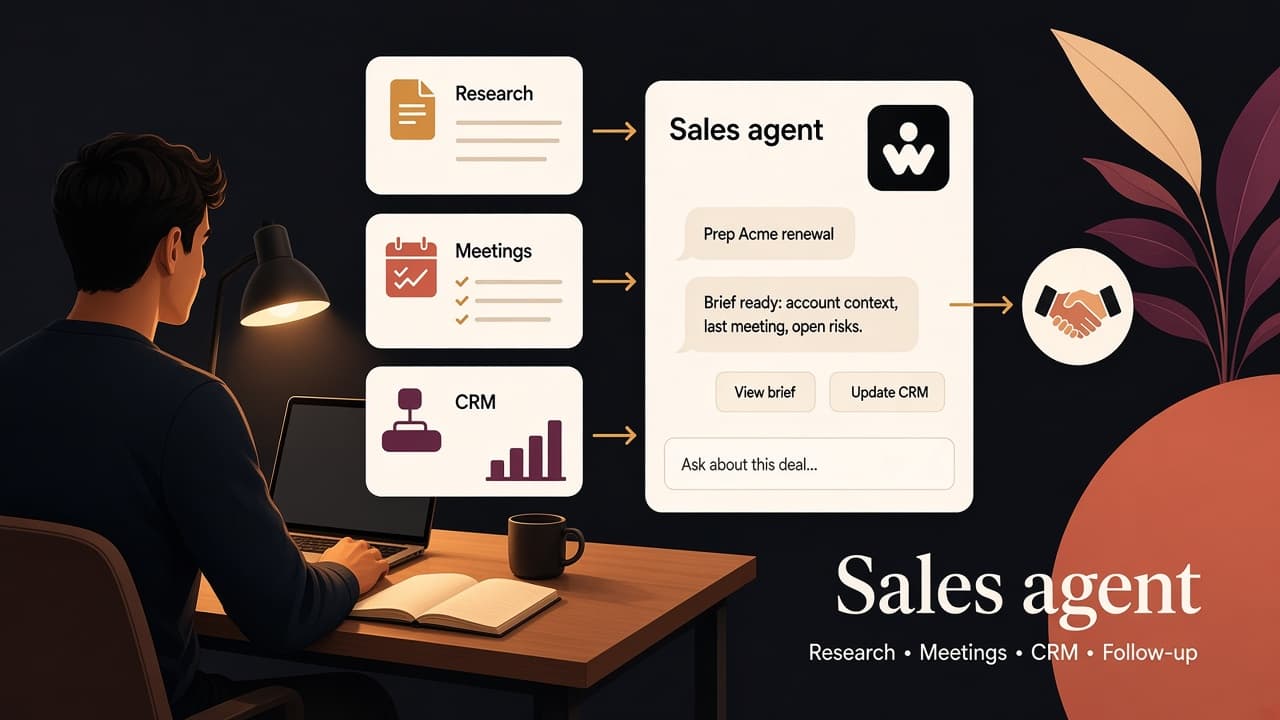
Most sales teams already use AI as a writing assistant. The next step is different: treat it as a teammate that can finish work, not only draft it.
That shift shows up in two places. One is the top of the funnel: finding and qualifying people before a rep spends time. The other is the deal itself: proposals, CRM, demos, and follow-up after the conversation has started.
A chatbot helps a seller think. Agentic AI plans the steps, uses company knowledge and connected tools, and keeps going until a person should decide.
The job is not “use AI in sales.” The job is to finish the work around the deal — with the seller still in control of the customer relationship.
Fill the funnel: more than a lead score
Lead scoring tells you who looks promising. It does not start the conversation, answer the first questions, or book the meeting. Agentic AI can do that work — with limits — so reps spend time on people who are actually ready.
Qualify over several messages, not one blast
An agent can talk with a prospect over email across more than one round:
- Answer common product and technical questions from approved materials
- Handle early objections (“not now,” “send more info,” “who else uses this?”)
- Check your qualification rules (company size, region, use case, budget range)
- Book a meeting only when those rules are met
- Hand off to a rep, with the thread attached, when the questions get commercial or personal
The point is not to send more cold email. It is to stop wasting a rep on a first-pass conversation that policy already knows how to run.
Customer-facing sends still need a person in the loop until the team trusts the path. Draft and route first. Send on its own only where the answers are standard and the limits are clear.
Start outreach when the account actually moves
Waiting for a rep to notice a funding round, a new leader, or a product launch is slow. An agent can watch target accounts for those events and prepare a short, specific sequence: why this company, why now, what to say.
That sequence should not wait in a prompt window. It should land where the team already works — Slack, email, CRM — ready to review. The first version can require a rep to approve the send. Later, low-risk touches can run on their own. High-risk or high-value accounts stay with a person.
This is how the top of the funnel grows without asking every rep to live in a news feed.
Run the deal: less admin, more selling
Once a meeting is on the calendar, a different kind of drag appears. Account executives lose hours to proposals, CRM, and prep. Agentic AI can take that load — again, inside rules you set.
Proposals and pricing inside a fence
A “deal desk” agent can:
- Build a custom proposal from approved content, not last year’s leftover deck
- Check margin and discount rules before a number goes to the buyer
- Answer first-round questions from the buying team that already have a standard reply
- Stop the moment the request crosses a price, legal, or commitment line
The fence is the product. An agent that invents a discount is not helpful. An agent that prepares the pack and waits for a person when the number is off-policy is.
Keep CRM current from the work you already did
Do not ask reps to retype the week. An agent can read email threads and call notes (including meetings an agent joined) and prepare:
- Deal stage and next step
- Close date and amount, when the conversation actually said so
- Who is involved, and what each person cares about
- Risks: a stalled next step, a missing decision-maker, an open support issue
Write to CRM only after the seller or manager can see what would change. Silent edits to the numbers destroy trust faster than empty fields.
WellSkate AI’s meeting agent fits here: record and transcribe across the video tools customers already use, write notes in your format and language, and turn the call into follow-up and a CRM update — instead of leaving the seller to reconstruct the conversation at 10 p.m.
Custom demos and pitch materials before the call
Before a pitch, an agent can gather what is public and what the company already knows: the prospect’s site, industry, current product, last meeting. It can then prepare a demo path and pitch materials that use the prospect’s language and branding, instead of a generic slide path.
The useful output is a brief the seller can run: which story to tell, which screens to show, which data examples fit. It is not a promise that every product can spin up a live sandbox on its own. Start with the brief and the materials. Add a live environment only if your product and security team already support it.
Limits and handoffs are how this actually ships
Autonomous sounds efficient. In sales, a wrong send, a wrong price, or a wrong CRM change is expensive.
Set hard limits on day one:
- What the agent may read
- What it may draft
- What it may send
- What it may write into CRM
- Which prices, terms, and promises are never allowed without a person
Then design the handoff. The agent should give the deal to a human the moment the work needs judgment, emotion, or a relationship — a tense buying-team thread, a main contact who went quiet, a legal edit, a verbal promise. The handoff should include the thread, the sources, and what the agent already tried. The rep should not start from a blank page.
A simple rule: let the AI prepare; ask a person before anything that cannot be undone. Draft the recap. Do not auto-send it. Prepare the CRM update. Do not silently change the numbers. Assemble the proposal. Do not invent a discount.
Which to do first: funnel or deal?
Both scale output. They do not pay off on the same clock.
Running the deal usually hits first. You already have meetings, email, and CRM. Notes, follow-up, and CRM updates are high volume and low drama. You can prove the agent finishes work in days, not quarters — and you keep a person on every customer send until trust is real.
Filling the funnel is the larger bet. Multi-message qualification and event-based outreach can grow pipeline without hiring in lockstep. They also touch brand, legal, and inboxes you do not fully control. Start with a narrow list, approved copy, and a required approval on the first send.
A practical sequence:
- Meeting notes + CRM next step + follow-up draft for one team
- Meeting briefs for the same accounts
- Proposals and discount checks inside a price fence
- Qualification and event-based outreach on a small, named list
Teams that try to automate finding leads, pricing, and closing in week one recreate the whole sales process inside a prompt. Teams that ship one finished loop free up time — and get a pattern the next process can reuse.
How WellSkate AI approaches this
WellSkate AI is built for custom AI agents and Agentic Workflows on work sales already runs — without standing up a separate AI engineering team for every process.
- Funnel — agents can watch knowledge, calendars, and connected tools, prepare outreach, and qualify against rules you define
- Deals — agents use CRM context, documents, and meeting notes to prepare updates, proposals, and next steps
- Meetings — agents can join video tools customers already use, capture the discussion, and turn it into notes, follow-up, and action
- Rules — human approval, the right access, and a record of what happened sit on the same path the team already uses — Slack, Teams, email, CRM
The point is not to replace sellers. It is to stop using skilled sellers as a search engine, a note-taker, and the person who types into CRM.
If your team can draft an email in seconds but still loses hours to prep, meeting notes, and CRM updates, you do not need more chat prompts. You need agentic AI aimed at finished sales work — with a clear fence, and a clean handoff when a person should take the deal.
Want to assemble a sales agent around pipeline, meetings, CRM, or follow-up? Explore WellSkate AI at wellskate.ai or contact contact@wellskate.ai.